
Seventy years after Pather Panchali released on August 26, 1955, we finally get it.
Shuttling between the village of Boral and a studio in Calcutta, caught between worrying about the next purse of funds and wondering which item to mortgage next, Satyajit Ray was explaining Indians to themselves, discovers Sreehari Nair.

Among other things, Satyajit Ray was a great student of sloth.
Worn-out zamindars, slow-moving matinee idols, young men seething with rage but powerless in the matter of expressing it, chess-obsessed nawabs and cowardly lovers who hold off making their moves -- oh, what a constellation of slothful sinners populates that dazzling filmography!
Simply put, Ray understood the cinematic possibilities implicit in an Indian unable to rouse himself into action.
He knew how to photograph such characters, knew how to bring out their special cadences.
There must be something innate about Ray's interest in sloth, for you can find clear evidence of it in his first film and his first reluctant hero. I am, of course, talking about the father in Pather Panchali, tobacco puffing, gently murmuring Harihar.

Harihar is a Renaissance man who can ill-afford that title, a man who fiddles with his sacred thread every time he's called upon to discharge his domestic duties.
Three parts priest and one part self-proclaimed playwright, he sees himself as too refined to chase after worldly possessions.
So when his wife suggests that he should divert some of his time and attention to getting back the family orchard that they have lost to some litigious neighbours, Harihar coos the ultimate artist's riposte: 'Let them keep the orchard. Unlike mangoes, rose-apples and coconuts, writers do not grow on trees.'
Harihar's inability to think on his feet is the reason for his wife's permanently wrinkled brow, and it's his mystical belief in himself and God that's at least partly responsible for his daughter's death.
These are harsh facts to contemplate given Ray's perceived softness, but I think they are necessary facts.

Satyajit Ray's humanism is a subject that gets thrown around with such abandon that, to the uninitiated, Ray might seem nothing more than a welfare worker with a camera. And Pather Panchali's status as cinema's universal pastoral has most certainly contributed to this image.
But complex artists do not wilt easily, not even under the weight of their reputations.
Seventy years since he first arrived on the big screen, Harihar, the impoverished Brahmin of Ray's first film, feels as undone by his passivity and his misplaced confidence as by fate.
Similarly, once we look beyond the automatic reverence that's accorded to each character in Pather Panchali, we can see what a dysfunctional bunch little Apu has to contend with, and how his consciousness develops out of their good intentions being constantly threatened by small failings.
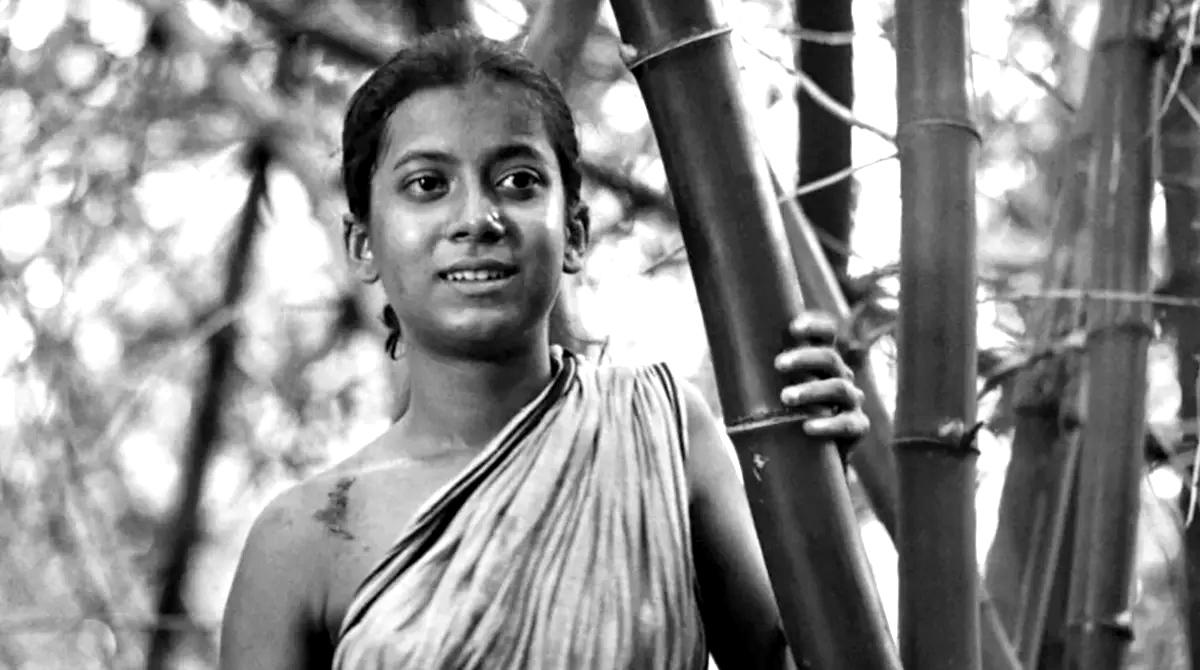
There's Durga, Apu's sister and Harihar's daughter, bursting with love for the mute and the weak but complete only in her temptations.
She's kindness and slyness judiciously intermixed.
Durga's darting eyes never miss an opportunity to pet (calves and kittens mature under her touch) or steal -- a fruit here for the old aunt who has taken residence in the Harihar household; a necklace there to be stashed away in her secret trinket box.

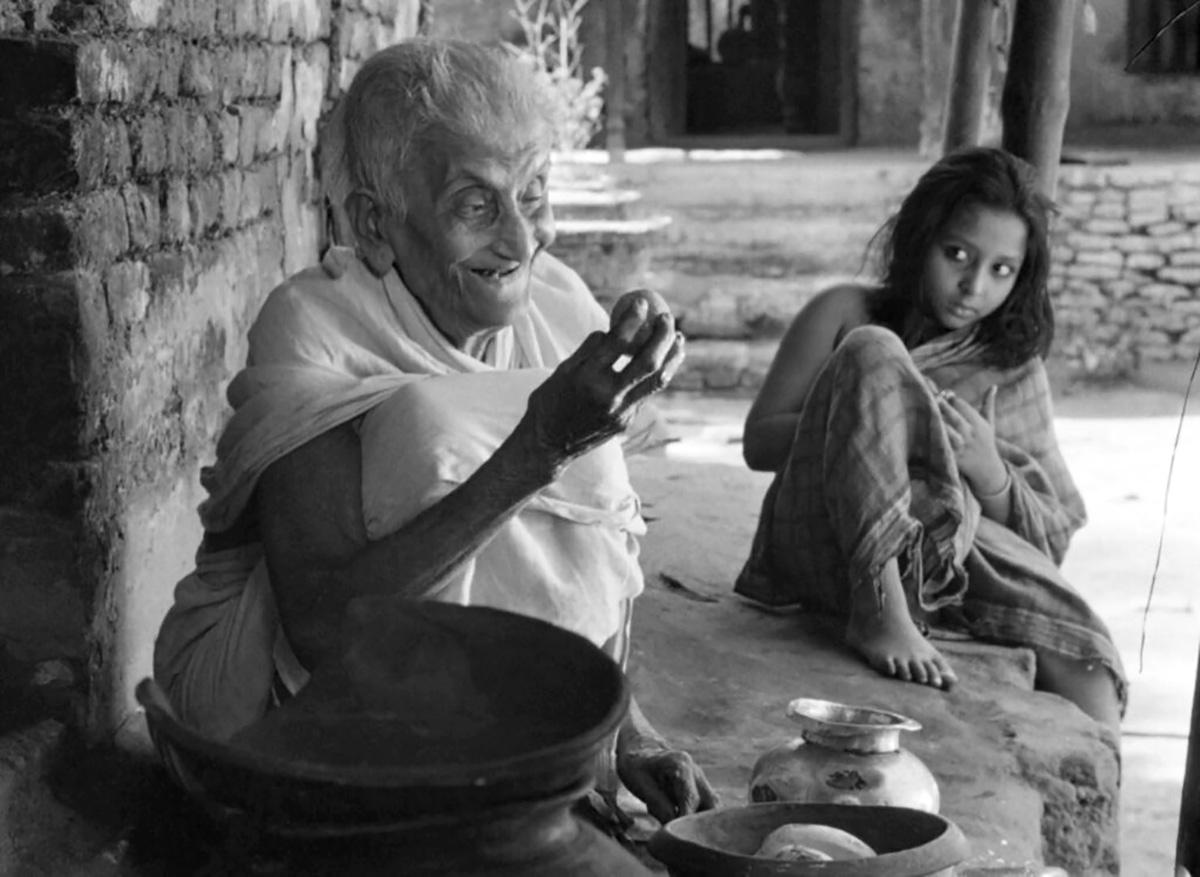
The aunt, Indir Thakrun, shares something of her benefactor's reptilian guile.
Every time Apu's mother isn't looking, Indir heaves herself to the kitchen and pinches off some salt or spice to flavour her daily chow.
A natural storyteller, she's the most charming parasite to have ever graced the movies, and she runs an underground economy in the house of utensils waiting to be pawned for food.

Now consider Sarbajaya, Apu's mother and Harihar's long-suffering wife, and consider the exquisite notes of cruelty in that stately lady.
Sarbajaya lashes out at the old aunt for invading her scant resources and blames her for encouraging Durga's propensity to steal.
The crooked crone responds by shambling into her makeshift hovel and muttering a few Bengali invectives of her pigtail years.

Little Apu grows up surrounded by all this kvetching and scheming, and how remarkable that one of cinema's greatest protagonists should be shaped out of an absent father and three women in perpetual conflict.
When a neighbour accuses Durga of stealing their bead necklace, Sarbajaya proceeds to drag her daughter out of the house by the hair, and as Apu watches this piece of courtyard Kabuki, you can feel the pulses beating in the boy's eyes.
For this violent scene, Ravi Shankar relies on a battery of percussion instruments, but for a typical dust-up between siblings he switches to the humble flute.
Though production notes have it that Ravi Shankar's work began only after the shooting was over, it's hard to believe that he wasn't present on location -- for the music of Pather Panchali captures the joy and agony of making the movie.
The musical choices seem to reflect such sensuous realities as how high the sun was on a particular day, or how densely packed the bamboos were in a grove, or, in the case of the hair-dragging sequence, the muscular exertion at work.
So precise is the score here that even the complete absence of sound in many scenes strikes you as well-thought-out musical choices.

I am not overstating when I say that there's a visionary quality to Pather Panchali that the humourless are apt to miss in their grave pursuit of the film's subject matter.
And we have examples for this on both sides of the taste divide.
There was Nargis Dutt, actress and parliamentarian, who had charged Ray with 'exporting poverty to the West', and there was Bosley Crowther of The New York Times, who had famously said, 'Pather Panchali illustrates how even very poor people can enjoy the little pleasures of their world.'
And the ruminant tale laughs at such pronouncements by being frequently funny.
Take, for instance, the moment of high comedy that caps the scene of Sarbajaya ejecting Durga from the house. We see the mother kneeling in the courtyard, ashamed of how she has treated her first-born, even as Apu emerges from his hiding place, washes his mouth, and reads his lessons out loud.
This is a kid learning to get by in the world, and to his credit, he never abandons his studies.

Toward the end, after Durga's death and before the family leaves for Benares, Apu discovers the stolen necklace inside his sister's secret box, and without stopping to inform anybody, he hurls it into the pond by his house.
In that quietly pragmatic boy, we can find the makings of the teenager in Aparajito, who chooses college in Kolkata over performing his mother's last rites in the village, and later the man in Apur Sansar, who sacrifices the manuscript of his first novel to the valleys.
While The Apu Trilogy is often described as 'leisurely', its central figure is clearly someone who believes in getting on with it.
And from whom does Apu inherit this attitude but his mother?
It might be interesting to examine Sarbajaya's jagged appeal at this point.
She's not Mother India, Nargis' embodiment of endless sacrifice, just an Indian mother who walks that graceful Bengali walk and takes tough decisions.
In the scene of her banishing Indir Thakrun from her premises, Sarbajaya can see death written all over the shrivelling, trembling granddame. But this mother doesn't budge. She knows there are too many mouths to feed and limited rations. So off goes the old aunt into the weeds, to pass through nature to eternity.
About Satyajit Ray's humanism, then -- I don't think it can be boiled down to a few Hallmark card sentiments.
And here's what's indisputable: Ray's humanism was not some plea for legislative reforms.
If anything, a big part of his artistry was that he never sweetened his disadvantaged, his downtrodden, his bums, his slugs.
Think how unusual this is coming from someone with Ray's background.
He was a blue blood, a city-bred man descending from a long line of progressives and philanthropists.
A lineage like that confines you to fixed impulses, among them the impulse to read Bibhutibhushan Bandyopadhyay's source material as a pamphlet, and to paint its characters with a patronising brush.

But Ray's humanism was built of sterner stuff.
He was more interested in what made these people tick, their survival mechanisms, their coordinates of grace and cunning.
He was interested in how they created poetry by worrying about very basic things.
Sarbajaya talks wistfully about her expenditure list; Harihar slurps deliciously while discussing his job prospects; the children are hypnotised by everyday enticements and cajole for coins. And as the old aunt falls down dead, her laments start to fill the dewy air, snatches of her favourite twilight number.
'The bulbuls have eaten my rice, how shall I pay the tax?' she would sing.
So here's Ray trying to film a hard-pressed life, and it's surreal how closely it parallels his struggles to get the movie made.
Mortgaging his wife's jewels, selling off his gramophone records, and praying for grants to arrive, he ploughs ahead.
An avowed socialist, Ray was placed in the uncomfortable position of thinking a great deal about money. And it's safe to assume that he must have passed on some of his anxiety to his characters.
In a larger sense, he could not have made those characters so vivid if he hadn't felt their goodness, their exasperations, and their crazy faults to be extensions of his own.
He had to liberate them from the book in which he had first found them.
The events in Pather Panchali may come from Bibhutibhushan's novel; the quality of feeling is Satyajit Ray's.
I can picture him now. Ensconced in his study, dismissing a plume of cigarette smoke, showing his storyboards to Subrata Mitra (the master cinematographer was then as 'green' as the cast), and trying to find the right words for what would eventually become his visual philosophy: 'We must select everything for the camera according to the richness of its power to reveal.'
This statement is perhaps the closest we'll get to understanding Ray's humanism.
It's almost a manifesto for seeing.
It speaks to that combination that runs through all his movies like a galvanising fever: An unsparing eye and an eye for beauty.

Rewatching Pather Panchali last week, I was struck by how much we lose when we approach the movie as a demonstration of 'the poor as the pious'. And there are at least a dozen shots (passing shots, shots rarely memorialised) that urge you to think beyond frozen terms, to keep an open mind.
Indir Thakrun thrusts her sunken, toothless jaw right up against the camera and asks, 'What happened?' and it feels like a cinematographic breakthrough even to this day.
That extreme close-up is a magnificent tribute to those old women in Indian households who try to stay close to the action at all times, but, more importantly, it's a reminder that Ray was a tireless peruser of faces and bodies.
To him, the schoolteacher in Pather Panchali -- who hands out groceries, reprimands students by their first names, scratches his belly, and yawns, all the while reciting a 19th century prose poem -- is a figure of Balzacian proportions.
Here was a prodigious noticer, someone for whom gestures and movements had an almost spiritual significance.
The reflection of a sweets seller in a lake, captured in all his portly glory, is probably cinema's most enduring image of childhood curiosity. The tenor of the drama shifts when a drop of rain falls askew on the bald head of an innocent bystander.
In a narrative arranged according to the flow of seasons, nature performs its annual stunt of renewal silently beyond closed windows. Lily pads bloom and flutter like discarded flags; a snake emerges from the crevices of a home just emptied of its inhabitants.
And as for Ray's eye, you come to realise that his idea of beauty was nothing like John Ford's or Sanjay Leela Bhansali's. Even his mansions and his horizons had more depth, there was more to them than mere grandeur.
To screenshot a scene from a Satyajit Ray movie is to play the classic mug's game, for in Ray's world, beautiful things are always in the process of being transformed -- their evanescence makes them even more precious. This is not beauty as a monument to the maker's ego; this is beauty as an invisible dagger.

There's a moment in Pather Panchali that's emblematic of the Ray Touch, a moment that hardly gets a mention in the existing Ray scholarship.
It comes near the climax and involves that dignified mother, Sarbajaya.
After haranguing everyone and holding her unbeatable poise, she, too, steals a fruit.
Right then, we hear thunderstorms.
Later that night, when her daughter dies after playing in the rain, the mother takes it as a sign that God has punished her for her transgression.
The people in Pather Panchali are superstitious and harbour irrational fears; they are people who believe in the power of curses. And Ray, the rational man, does not so much dissect his characters as celebrate their essential mystery.
Perhaps this penetrating yet embracing vision is anathema to the Indian way of consuming art; perhaps this is why Ray is so often accused of being 'too western'.
But the truth is that Satyajit Ray directed Pather Panchali as though there had been no Indian cinema before it. And in telling the moving story of a family through a rush of elements, he showed us how we comport ourselves, our fancies and our pretences, our minor corruptions, and how our geographical peculiarities and our capricious weather alter our moods and sharpen our perceptions.
Seventy years later, we get it.
Shuttling between the village of Boral and a studio in Calcutta, caught between worrying about the next purse of funds and wondering which item to mortgage next, Ray was explaining Indians to themselves.
Photographs curated by Manisha Kotian/Rediff
