
Rishab Shetty's Kantara: A Legend Chapter-1 is an ambitious, bold update of the ideas of the first film on a much bigger canvas, discovers Arjun Menon.
Kantara: A Legend Chapter-1 is a film defined by ambition.
Every story beat, each inch of lore and each visual flourish have been accounted for, and expanded upon by Rishab Shetty and his collaborators to double down on the cultural impact and cinematic highs of its predecessor.
The hardwork, blood, sweat and tears gone into this mammoth undertaking is evident in each frame. This iteration of the Kantara universe manages to break free from the 'sequel/prequel curse' that has been a constant for popular films that transcend the boundaries of regional language based accessibility.
Kantara: A Legend Chapter-1 is an inspired prequel project that predates the first installment by centuries and transpires during the reign of the Kadamba dynasty in coastal Karnataka. 'Rooted' is an adjective that gets thrown around a lot when conversation around the 'Kantara verse' happens online.
This is not just a buzz word designed to boost engagement but the aesthetic principle of Rishab Shetty and his group of writers, who are tackling relatively untapped mythic concepts and rituals like 'Guliga' and 'Bhootkala'. All these facets of our age old culture have come to became mainstream with the worldwide success of the first film and it's undeniable cultural impact in the way we viewed local legends and mythology.
The film begins with the benevolent king (Jayaram), who has handed off his reign to his brash, irreverent son Kulasekara (Gulshan Deviah) who spends most of his time slacking off in alcohol.
The only reliable administrative hand being the king's younger daughter Kanakavathi (Rukmini Vasanth). This narrative is interlaced with that of a tribal population, headed by an un-assuming Berme (Rishab Shetty) who takes his first trip from their forest to the royal kingdom, which has been off limits for the tribe for generations.
Everything is new to Berme and his friends, who have never been exposed to the way 'civilised' society works. The film spends sometime in setting up their newfound excitement and 'fish out of water' dynamic.
Kantara : A Legend Chapter-1 is even more light on its feet and comedic as opposed to the first part, which had the levity distributed unevenly. Here there are funny stretches in plenty and you see Rishab trying to ground the larger than canvass of his highly imaginative ideas in some familiar fun.
Like most 'chosen one' narratives, Berme becomes the fulcrum around which kingdoms clash, tribals unite and all hells breaks out.
The scale does not overwhelm the second installment, unlike many sequels where original ideas are lost in the over zealous indulgence in the parts of the makers to make everything look, sound and feel bigger and event like.
Here the stakes are as high as ever, with imperial trauma and indigenous population's right to land being called upon as important themes like the first film, with even more deadly repercussions and historic context at play.
Rishab Shetty takes off where he left off in the first installment, and comfortably sides into the dissident warrior figure, who is tasked with protecting his native hive, which adopted him at a young age, and brought him up as their one of their own.
Dogmas clash, ancient traditions lock into conflicts and land becomes a major inflection point for the narrative. Rishab employs his renewed resources with much more scope and scale in this prequel, that uses its platform to delve deeper into the 'Guliga' mythology.
The world building is intimate yet wide reaching. Rishab and his team foregrounds the central conflict, and sets up the stakes of the Kadampa era spice trade and business as background detail, that add much specificity to the mileu.
Traders, foreign investors and international trade are suggested through the sets, costumes and production design adding much needed sociological context of the times.
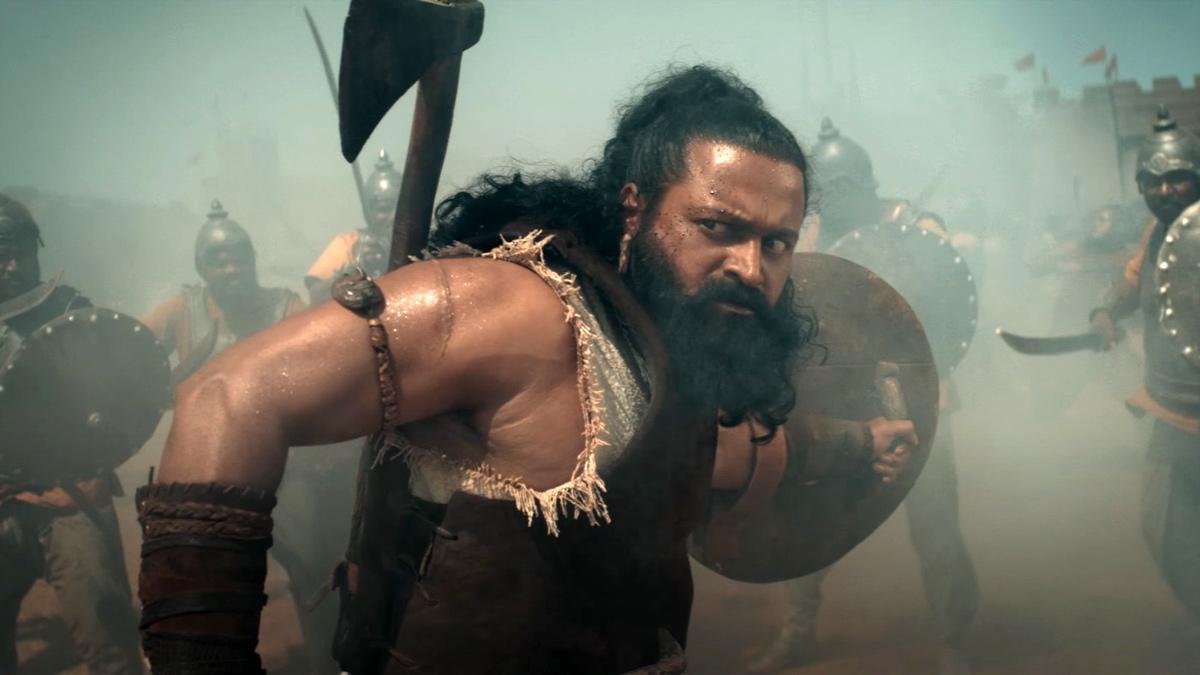
Rishab Shetty tasks himself with some even more unbelievable physical acting moments in the film, especially like the post interval tribal ambush lead by the clueless young king Kulasekara stretch, which is a showcase for Rishab to launch into a chilling continuation of his work in the first Kantara. The scenes features him transitioning between different modes of 'Guliga', after being forced to fend of the evil king and his men from massacring his tribe.
Rishab uses every ounce of his energy and physical prowess to make the different volatile 'Guliga' poses work, maintaining the gestures, body movements and the visceral screams of pain and anguish that bellows and sparkle the scenes.
Rukmini Vasanth is steady and eternally luminous as the more than capable princess, with an interesting relationship dynamic with the rebellious and stubborn Berme. Jayaram is world weary as the king caught between age old horror stories and personal scars that have been passed down through generations in his family and kingdom.
Gulshan Devaiah elevates a single note, irritating villian archetype into a splendidly unhinged performance that uses both the physicality and a sort of repellant charm to make the villiany stand out. The comic side characters also deliver the goods, though sometimes the film overemphasises the banter in important scenes as momentary pockets of relief in between all the gritty action.
Cinematographer Aravind Kashyap is one of the biggest assets of this grant production. He conjures up the wet, mushy lighting schemes and frames his images in a way that the background is as critical to the story as the subjects swirling around in the foreground. Like the first Kantara, he manages to stage night scenes and action blocks with a sort of hand held mobility.
In two action blocks in the forest, Rishabh and Aravind decide to go in close to the action with single pan's back and forth without cuts at quick pace. There is a tactile energy to the film resulting from these choices.
Ajaneesh Loknath triumphs yet again with a thumping score that uses prayers, chants and concealed anguish to exemplify the action blocks. There is an ambient energy that he adds to the material. The finale is as explosive, if not more than the first installment.
Kantara: A Legend Chapter-1 is clearly aiming beyond replicating similar affectations to that of the climax of the first film. It's like a new portal opening up that contains a well of new myths, ideas and histories to be unearthed.
It's a sight worth beholding on the biggest screens available. This second film continues to elicit genuine awe, wonder and disbelief at the some of the outrageous ideas at the centre of Rishab Shetty's Kantara lore and what he plans to do with this vast universe going forward, which may or may not be everyone's expectations from such a tentpole sequel.

