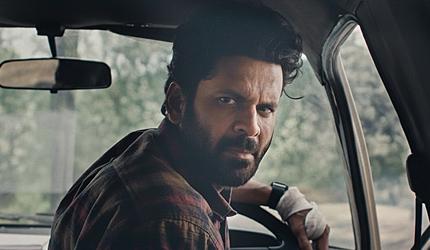
'It is daunting, for sure, because you're rowing upstream.'
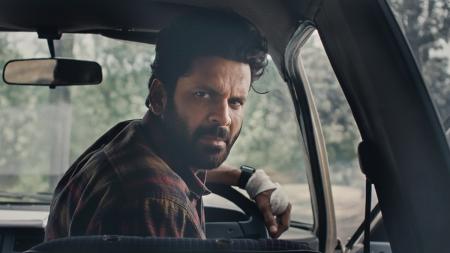
In the age of high-speed entertainment, some films compel you to slow down to take notice of their beauty.
Raam Reddy's Jugnuma: The Fable is that kind of film.
Reddy is a true indie darling, whose debut feature Thithi set him apart as a standout talent and won him a National Award in 2016.
His muted and introspective style is once again on display in his second feature, which tells a story about an orchard owner whose peaceful life in the Himalayan foothills is disrupted when a mysterious blaze engulfs his sprawling fruit estate.
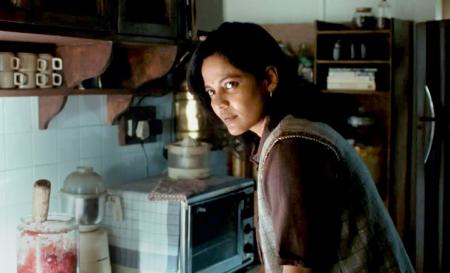
Headlined by the ever dependable Manoj Bajpayee, alongside Deepak Dobriyal, Priyanka Bose, and Tillotama Shome, the film is brought into mainstream view by Guneet Monga and Anurag Kashyap.
"It was very challenging for all of us working independently to get things out but now, that support has started coming through via champions. My film is being presented by Guneet (Monga) and Anurag (Kashyap), and they were keen that it was seen on a big screen. That's not always the easiest thing for an Indie film," Raam Reddy tells Mayur Sanap/Rediff.
Tillotama Shome, who acted in Jugnuma, described the film as 'Dum Biryani'.
(Laughs) Yeah, she did.
The film has been in the making for about eight years.
Now that the film is finally out in cinemas, how do you look back at he hardships of the making?
It dissolves the moment you have it out.
The dream is kind of fulfilled, and then all the struggles dissolve into that positivity.
I've been carrying it for so long on my shoulders.
I feel light.
You once described yourself as a perfectionist. What was the hardest part of making this film?
All of it was quite hard.
I think maybe it was getting the VFX to blend seamlessly with the 16mm impressionistic style. VFX is very hard to turn invisible.
The world building was always one of the key aspects for me.
Then we had to shoot season specific. The dream was to go and shoot in the blossom in the orchard.
The blossom in the orchard in Uttarakhand is such such a dicey thing because you don't know when it's going to happen as it happens differently every year.
We were watching the seasons, and we were like, okay, let's just pray that when the unit is up in the hills, and we're shooting in those locations, the bloom is there.
That full bloom period is really short. It lasts only for a week, you know, like the Japanese cherry blossoms.
Working around that was extremely stressful.
Just before we shot the final scene, everything was perfect, the bloom was perfect, the timing was perfect.
And there was a hailstorm out of the blue. A hailstorm, which didn't happen at the time of the year.
All the flowers fell off the trees. We had to recreate the flowers in CGI.
That was crazy!
The shooting was extremely challenging. The remote location was extremely challenging. Merging actors and non-actors seamlessly was challenging.
But all these challenges have made the film what it is.
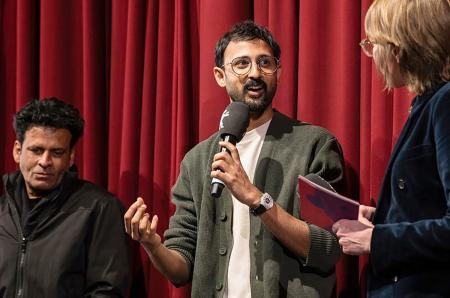
You once said that Jugnuma is a very personal film.
Yes. Some of the internal struggles that Dev (Manoj Bajpayee's character) is going through, whether how attached he is to the material world around him, and is there some way to shed some of that weight to find something deeper has been a question I've had since I was young.
I always wanted to try to find a narrative which would address that in a subtle manner.
The tone may be internal (but) I've always wanted to tell a story that excites people because I'm a restless person.
Even when I'm watching films, if the narrative isn't gripping, I'm not going to access the deeper layers internally.
I wanted to take that question, and some experiences from my childhood, spending time in those estates in the south.
Lastly, the draw to magic realism as a genre is my favourite.
It's a slippery genre in some ways, it's something that you can't really completely hold on to when you're experiencing it.
As an artist, it was really exciting for me to design my own magic realism.
Before Thithi I had written a magical novel. So to come to that genre again is where I stand as an artist.
For all these reasons, it was very meaningful to me.
Also, I'm really glad that I collaborated with Manoj, who had a similar connection to the script.
He was also in that internal meditative space, seeing the conflict with the material world, when the script came to him.
What I also liked about the film is the gorgeous Himalayan setting. Manoj Bajpayee said that he almost forgot that he belonged to Mumbai when he was shooting for Jugnuma.
The Himalayas have been here long before us, and they'll be here long after we're gone.
They're just this timeless space.
I had this vested interest to spend time there for my own inner journey.
There's an aura in that place that feels like magic could almost be real.
As a setting for a magic realism film, it was perfect.
Because it was so remote, and we were in the midst of nature, you forget that we live in concrete jungles.
We really did get lost in that world.
Is it true that you edited 45 minutes out of the final version?
Yes.
That must be disheartening.
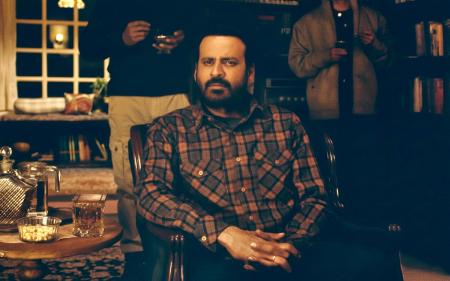
It happens to many films, but the reason it was a little harder in this film was that those 45 minutes were the same quality as the film that you see.
So cinematically, it was hard to let go of those moments with this wonderful cast.
But as they say, the whole is more important than the pieces.
Your debut feature Thithi won the National Award. Was it harder to make your second film after that recognition?
As an artist, you want to do better.
I put that pressure on myself.
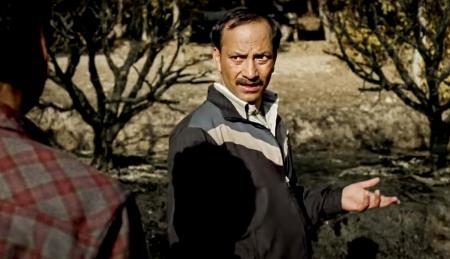
I was young when Thithi happened, and I had so much support for that film. Without the journey of Thithi, I wouldn't have been able to put this film together.
Every senior cast member said they said yes to this film because they had liked Thithi.
Thithi was in Kannada, your debut short film Ika was in Telugu, and Jugnuma is in Hindi and English. Do you think of a language first when you write stories?
Honestly, the language comes a little later.
It's more like what I want to say, and then I end up finding a setting. Which one I pick for a particular story depends on the concept and other things like the actors that you want to collaborate with.
So the language comes early, but not first.
I enjoy working across languages, across settings. It's enriching.
For example, for Thithi I spent two years in a village and learned a lot.
For Jugnuma, I lived in the mountains.
Those experiences are very valuable.
My mother tongue is Telugu, but I've been brought up in Bangalore. I went to an English medium school.
I studied in Prague, where I made a film in Czech.
Before that, I did my bachelor's degree in Delhi University, where it was Hindi. Now, I am living in Bombay.
All these languages are dear to me.
What was the influence of cinema on you as a child?
I had no interest in cinema till I was about 20.
As a child, I was more into sports as well as poetry and photography.
When I was in college, there was this epiphanous moment where I realised that all my different interests converge in cinema. Then I became extremely hungry for cinema.
I started watching everything I could.
I tried to expose myself to as many kinds of cinema as possible.
It's unique how each country treats cinema so differently. The feeling of time and space is so different. The narrative structures are so different.
I remember watching Lord Of The Rings in my late teens. It's a little cliché, but that's where I saw the power of cinema, creating a world that never existed.
The world Peter Jackson built from Tolkien's novel, I was like, what am I witnessing? How do humans create such vivid, lifelike, lucid, dreaming almost? It's so powerful.
Then I got really interested in film-makers, who had that sense of scale in world building.
When I was in Prague, I was exposed to Serbian director Emir Kusturica's works. Then Francis Ford Coppola's work.
What challenges did you face when you came back to India to make films?
Honestly, it wasn't much of a struggle because I came into a project like Thithi, which was completely outside of the industry per se.
Also, some of my key collaborators were from Prague and it was our first film after film school.
There was barely anybody who was like a real professional on that film.
It wasn't until Jugnuma that I understood some of the realities of how the industry works, where the focuses sometimes are, and what your challenges are to tell a story from the heart within the structure of the industry.
Those challenges were immense because I look at cinema differently.
So getting everyone on the same page is really challenging.
Partly why Jugnuma took so much time is because you have to wait for things to come together.
The budgets are bigger, and you need to manage things very differently. That scaling up was very challenging.
It's becoming a little easier because after these two films, when I approach people to ask them if they'd work with me, they know that I'm off the beaten path.
But making a film is one of the hardest things in the world.
What are the other interests that keep you busy when you're not filming?
I'm really into music now.
I'm training my voice, and starting to learn songwriting because it's similar to writing.
I'm trying to work on music and understand it better. Also, to use it in my own films.
The second track in Jugnuma is something I performed.
I'm also into exercise because I was a national level basketball player growing up.
I played for Karnataka and got into Delhi University through the sports quota.
But I ended up being a very bad player!
You come from a family with political lineage. (His grandfather K Chengalaraya Reddy was the first chief minister of Mysore state). Were you ever inclined towards politics at any point?
My grandfather was a freedom fighter. I never met him because he passed away in the 1970s.
I was born in the late 80s.
He had mentioned to his children, to my father, that maybe they try something else and not get into politics, so none of them did.
There's a speech on YouTube he's given, which I listen to quite often. He was a great, great man.
I feel connected to the spirit, but can't imagine what that world was like at the time and what they had to do to fight for basic rights.
I feel fortunate to have not inherited a world like that.
Now, I don't know what the world is going through. I hope it heals soon.
Your films don't have a grammar of regular films, in the sense, they don't really fit into the mainstream box. As an indie filmmaker, what are the struggles to find a theatrical release?
It is daunting, for sure, because you're rowing upstream.
It's almost like a minor rebellion, and you don't know if the rebellion will be successful or crushed.
But it's daunting more from the commercial point of view.
From the artistic side, it's very exciting, very gratifying. You feel fulfilled.
I really hope I can continue to make films the way I do.
Independent cinema is experiencing a significant comeback with a newfound interest from the audience. That must be encouraging.
It's an exciting time. It seems like a little upswing, this happens every now and then.
It was very challenging for all of us working independently to get things out but now, that support has started coming through via champions.
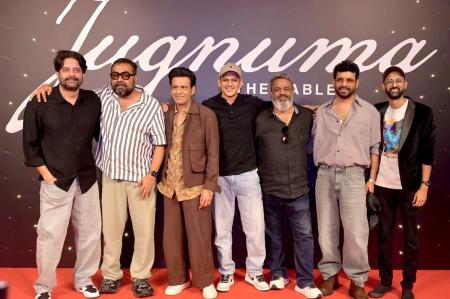
My film is being presented by Guneet (Monga) and Anurag (Kashyap), and they were keen that it was seen on a big screen. That's not always the easiest thing for an Indie film.
Of course, Manoj Bajpayee is in the film.
A director friend of mine messaged me yesterday saying, you have an army behind you.
I can't believe how this happened but it's true.
I feel humbled.
What comes next?
I have been thinking of something.
I don't always start with an entire story. I start with something that really draws me.
Right now, I think that's music. I am starting to build something.