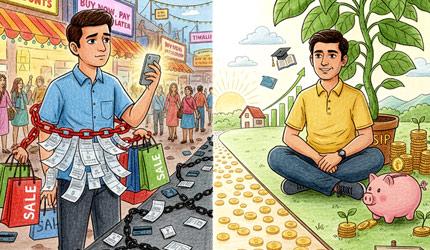
EMI means you've already spent tomorrow's income; SIP means you're investing today's income to secure tomorrow, explains Ramalingam Kalirajan

Ever found yourself tempted by that flashy '0% EMI' offer while shopping online?
Or thought, 'Why wait when I can just pay in installments?'
It sounds convenient, right?
But have you ever paused to ask -- what's the real cost of that convenience?
Are we really owning what we buy, or are our EMIs slowly owning us?
In a world that celebrates instant gratification, could the smarter move be to save first and spend later?
1. The Festive Season Temptation: Swipe Now, Think Later?
Festive lights are on, discounts are glowing, and e-commerce apps are buzzing with 'Buy Now, Pay Later' banners. Tempting, isn't it?
New phone, a better car, or that foreign vacation -- everything seems within reach when EMIs look 'affordable.'
But pause for a second and ask yourself -- are you truly affording it, or just borrowing your future income?
When every festival pushes us to spend, few people stop to ask: What if I saved first, instead of borrowing later?
2. EMI vs SIP: The Same Outflow, Two Different Mind-sets
Both EMI (Equated Monthly Instalment) and SIP (Systematic Investment Plan) seem similar on the surface.
Money leaves your account every month -- one for a purchase you've already made, the other for a future you're building.
But in reality, they represent opposite financial mind-sets:
So, one makes you obligated, the other makes you empowered.
3. The True Cost of Buying on EMI
Let's be honest -- EMIs aren't evil.
They are useful for essential purchases like your first home or education.
But the problem starts when every 'want' becomes an EMI.
The phone, the vacation, the car upgrade -- they may bring short-term joy but long-term liability.
For example, Rs 5 lakh product bought on EMI at 12% interest over 5 years will cost you around Rs 6.67 lakh in total.
You are paying nearly Rs 1.67 lakh extra -- just for buying it earlier.
So, are you really getting a discount, or are you paying a premium for instant gratification?
4. The Power of SIP: Let Your Money Work Before You Spend It
Now imagine taking the same Rs 11,000 you would have paid as an EMI and putting it into a Systematic Investment Plan instead.
Over 5 years, at a 12% annual return, you'd invest roughly Rs 4.64 lakh and end up with Rs 6.38 lakh -- enough to buy that same product, even after accounting for inflation!
In short, with SIP, you earn before you spend. You're in control of your money -- not the other way around.
5. When Enjoyment Turns into Enslavement
It's okay to enjoy life's comforts -- after all, money is meant to enhance your life.
But when 'Buy Now, Pay Later' becomes a habit, freedom slowly fades.
You start earning for your past purchases instead of your future dreams.
And if life throws a curveball -- a job loss, a business slowdown -- those monthly EMIs don't stop.
That's how financial stress begins.
As a thumb rule, your total EMIs shouldn't exceed 40% of your post-tax income. Anything beyond that is a red flag.
So, the next time your favourite app flashes an EMI offer, ask yourself: Is this a need, or just a momentary want I can plan for later?
6. Crunching the Numbers: EMI vs SIP Example
Let's look at the real difference numbers can make.
Suppose you want to buy something worth Rs 5 lakh -- maybe a car, a high-end gadget, or a family trip.
You have two choices: buy it now on EMI or save through SIP for five years.
|
Details |
EMI (Loan) |
SIP (Investment) |
|
Product Cost Today |
Rs 5,00,000 |
Rs 5,00,000 |
|
Interest / Return Rate |
12% p.a. |
12% p.a. |
|
Tenure |
5 years |
5 years |
|
Monthly Outgo |
Rs 11,122 |
Rs 7,736 |
|
Total Outflow |
Rs 6,67,333 |
Rs 4,64,179 |
|
Future Value (after 5 yrs) |
Rs 0 (loan closed) |
Rs 6,38,141 (corpus built) |
With EMI, you enjoy the product immediately but pay interest for the privilege -- spending over Rs 1.6 lakh extra.
With SIP, you delay the gratification a little but earn returns that help you own it outright later, without debt or pressure.
In simple terms, EMI costs you for spending early, while SIP rewards you for waiting wisely.
7. The Smarter Way to Enjoy Life's Rewards
What if your next big purchase came from your investments, not your loans?
That's the real joy of planning through SIPs -- your purchases feel lighter because your money has already done the heavy lifting.
No lender, no interest, no anxiety.
You can still enjoy your festivals, vacations, or upgrades -- just with a mind-set that says 'I'll buy it when I can truly afford it.'
It's not about delaying happiness; it's about owning it with confidence.
8. Final Thought: Balance, Discipline, and Financial Freedom
Life's not about choosing between gratification and saving -- it's about creating a balance where both coexist.
By saving first and spending later, you turn your financial life from a cycle of repayments into a journey of rewards.
And if you're unsure where to begin, a Certified Financial Planner (CFP) can guide you toward that balance -- helping you enjoy today without compromising tomorrow.
Ramalingam K, an MBA in Finance, is a Certified Financial Planner. He is the Director and Chief Financial Planner at holisticinvestment, a leading financial planning and wealth management company.

Disclaimer: This article is meant for information purposes only. This article and information do not constitute a distribution, an endorsement, an investment advice, an offer to buy or sell or the solicitation of an offer to buy or sell any securities/schemes or any other financial products/investment products mentioned in this article to influence the opinion or behaviour of the investors/recipients.
Any use of the information/any investment and investment related decisions of the investors/recipients are at their sole discretion and risk. Any advice herein is made on a general basis and does not take into account the specific investment objectives of the specific person or group of persons. Opinions expressed herein are subject to change without notice.