
Gen Z, driven by AI anxiety and economic pragmatism, have concerns about pursuing passions as careers as they fear it may not make them enough sufficient income.
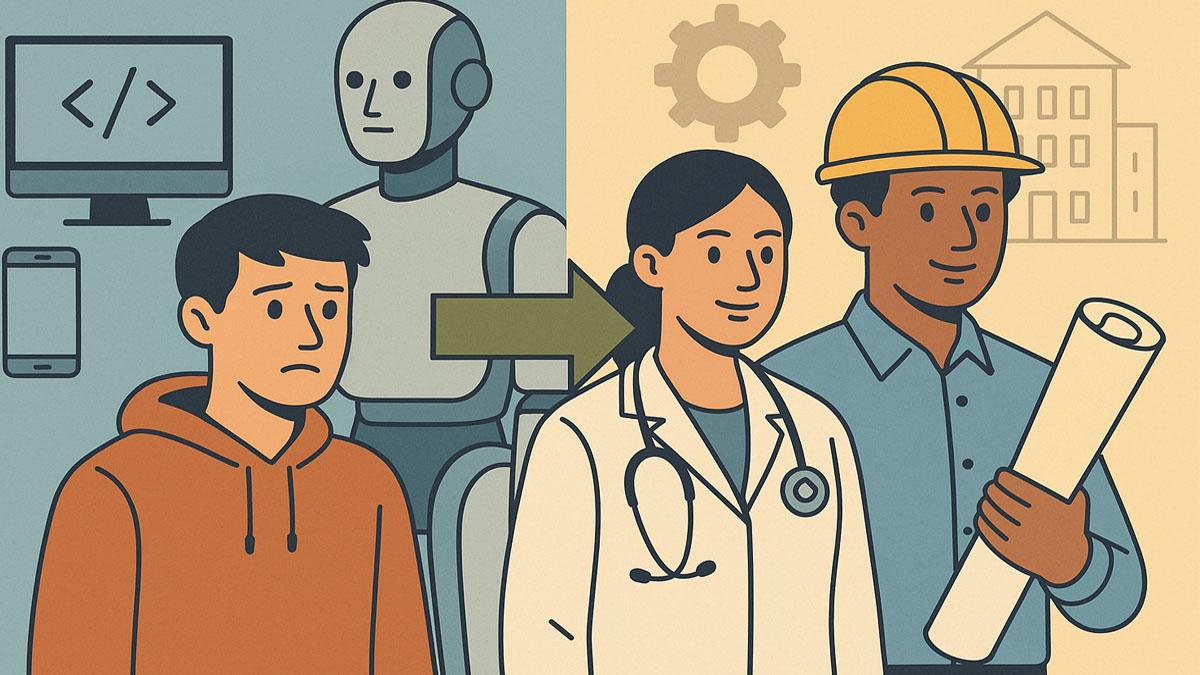
The career aspirations of the world's most connected generation are taking an unexpected turn. While previous generations dreamed of joining tech titans like Google and Apple, Generation Z is charting a decidedly different course -- one that leads to hospital corridors rather than corporate campuses.
A comprehensive survey by the National Society of High School Scholars (NSHSS) (external link) of over 10,000 high-achieving students across all 50 states in the US reveals that nearly half (48 per cent) of next-generation workers say the most important quality in an employer is clear communication skills, signalling a fundamental shift in workplace priorities that could reshape entire industries.
The Healthcare Surge
The NSHSS data paints a striking picture of generational change.
The top career fields of interest include medicine/health-related (24 per cent), healthcare (22 per cent) and engineering (18 per cent).
This healthcare obsession isn't merely academic -- it's deeply personal.
The survey reveals that healthcare and health-related issues have become the most pressing concerns for Gen Z, largely driven by their own experiences with health challenges during their formative years, which were marked by a global pandemic.
This preference extends to their dream employers. Gen Z has a strong interest in working in healthcare settings, with their top three preferred employers being St Jude Children's Research Hospital, Mayo Clinic and Healthcare Service Corps.
In India, this trend is mirrored by record-breaking interest in medical careers.
According to the National Testing Agency (NTA), the number of applicants for NEET UG 2025 reached an all-time high of 2.4 million, indicating a sharp rise in Indian Gen Z's interest in healthcare, medicine and life sciences following the COVID-19 pandemic.
While tech giants haven't completely vanished from the US radar -- Google, Amazon and Apple also made the top 10 list of desired employers, coming in at seven, eight and nine respectively -- they've been decisively dethroned from their previous positions of dominance.
AI anxiety factor
Perhaps nothing explains Gen Z's career pivot more clearly than their relationship with artificial intelligence.
More youth (59 per cent) believe that AI will have more of a negative impact than a positive one on society in the next 10 years.
More than half (55 per cent) are extremely or very much concerned about AI's impact on personal privacy and 62 per cent are worried about job displacement.
This scepticism regarding AI represents a profound generational paradox.
The generation that grew up with smartphones, social media and instant connectivity now views the next wave of technological advancement with deep suspicion. Their concerns aren't abstract -- they're acutely aware that AI could automate away the very careers their predecessors built fortunes on.
In India too, a 2025 survey conducted by TeamLease EdTech (external link) revealed that nearly 60 per cent of Indian college students feared that artificial intelligence would negatively impact job opportunities, particularly in traditional IT and software sectors -- long considered India's employment backbone.
Passion Versus Paycheck Dilemma
Gen Z faces a stark economic reality that's reshaping their career calculations, according to the NSHSS findings.
The majority (63 per cent) have concerns about pursuing passions as careers as they fear the former may not make them enough sufficient income.
This pragmatic approach extends to their financial planning where almost half (41 per cent) believe that student loan debt has or will prevent them from pursuing their passions.
The generation isn't relying on family wealth to navigate these challenges.
One quarter of students expect to incur anywhere from $10,000 to $50,000 in student debt but just 14 per cent said they expected family assistance as a component of how they'll pay for college. Instead, they're banking on scholarships and strategic career choices to manage their financial futures.
In the Indian context, despite the growing visibility of liberal arts and creative streams, most students still prefer engineering, medicine and management courses due to greater job stability. According to annual employability reports from the All India Council for Technical Education (AICTE) (external link), employability remains the single most influential factor in stream selection, especially in tier 2 and tier 3 cities.
Living At Home, Thinking Long-Term
Gen Z's approach to post-graduation life reflects both economic pragmatism and shifting cultural norms.
Two-thirds (66 per cent) expect to live at home when they start their first job and three quarters (73 per cent) plan to stay at home for one to two years. This isn't failure to launch -- it is strategic financial planning in an era of rising living costs and student debt burdens.
The NSHSS survey shows that 66 per cent say they'll live at home after college graduation to further be able to pay for student loans, demonstrating a generation that's willing to sacrifice traditional independence markers for long-term financial stability.
This mindset is even more common in India, where multigenerational households are deeply rooted in tradition. A 2024 survey by online education platform upGrad revealed that over 75 per cent of Indian graduates prefer to stay with their families for two to four years after entering the workforce, citing rising rent and financial security as key reasons.
Workplace Revolution
Their expectations are reshaping employer strategies across industries.
Health benefits trump time-off and flexible work schedule as their most valued compensation benefits, with 72 per cent saying health benefits, 25 per cent work-life balance and 61 per cent saying flexible work schedule.
The emphasis on health benefits aligns perfectly with their healthcare career interests and suggests a generation that's witnessed firsthand the importance of comprehensive medical coverage.
When it comes to workplace culture, fair treatment of all employees continues to rank #1 of all workplace preferences (28 per cent rank it first), followed by work life balance (25 per cent) and corporate social responsibility (14 per cent).
They also expect substantial investment in their development -- 67 per cent say they expect employers to offer in-person training.
Indian employers have begun to respond accordingly. Firms like TCS, Infosys and Apollo Hospitals have expanded wellness programmes, mental health support and hybrid work options to meet the evolving needs of Gen Z professionals, according to reports by the Confederation of Indian Industry and NASSCOM in 2025.
Bottom Line
Generation Z's career preferences, as revealed in the National Society of High School Scholars' comprehensive survey, signal a fundamental shift in Gen Z's workforce priorities. They are choosing stability over disruption, human connection over algorithmic efficiency and social impact over pure profit maximisation.
For employers, this means rethinking recruitment strategies, benefit packages and corporate culture to attract a generation that's redefining professional success.
The implications extend far beyond individual career choices.
As Gen Z enters the workforce in greater numbers, their preferences could drive significant capital flows away from traditional tech sectors toward healthcare, education and other human-centred industries.
Companies that fail to adapt to these shifting priorities may find themselves competing for talent in an increasingly challenging environment.
The generation that was supposed to be most comfortable with technology is instead choosing careers that technology can't easily replace -- a strategic decision that may prove prescient as artificial intelligence continues its relentless advance into the professional world.