A study reveals that global tech giants surprisingly prefer skills over IIT and IIM tags which no longer guarantee entry into the world's most innovative workplaces.
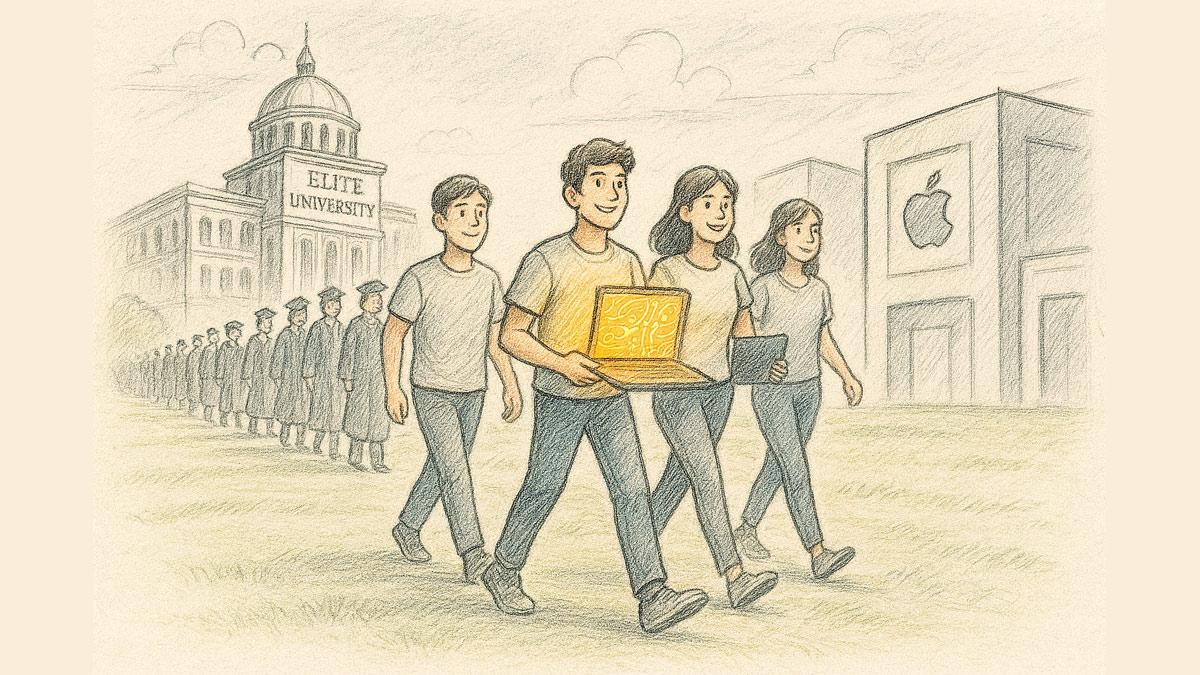
A new survey by the professional networking app, Blind, has unearthed a seismic shift in India's tech recruitment landscape.
The study reveals that pedigree is giving way to performance, with one in three (34 per cent) employees at global firms like Apple and Nvidia having graduated from Tier-3 universities.
This surprising trend suggests that the coveted Indian Institutes of Technology (IIT) and Indian Institutes of Management (IIM) tags no longer guarantee entry into the world's most innovative workplaces.
The long-held belief that an IIT or IIM degree is the exclusive gateway to a top global technology career has been comprehensively challenged by this study.
Anonymous professional networking app Blind surveyed 1,602 Indian tech professionals, revealing that a staggering number of employees at firms like Apple, Nvidia and Zoho hail from universities previously classified as 'average.'
According to the Blind app's findings, a substantial 34 per cent of the surveyed workforce at these high-profile companies reported graduating from Tier 3 institutions (categorised as other state and private universities, outside the Tier 1 elite and Tier 2 national universities).
This suggests a deliberate and significant broadening of the talent pipeline by some of the world's most successful technology firms.
The rise of the Tier-3 graduate
*The study grouped colleges based on the National Institutional Ranking Framework (NIRF) 2025: Tier 1 (including IITs and IIMs), Tier 2 (including NITs and DTU), Tier 3 and Tier 4 (overseas institutions).
The results suggest that while traditional finance and service recruiters such as Goldman Sachs and Oracle continue to favour Tier-1 pedigree, progressive tech giants are focusing on demonstrated aptitude.
This is further evidenced by a participant from Salesforce, who noted that while Tier-1 graduates historically show a higher interview success rate, the industry is increasingly 'hunting grads from small towns and Tier-3 colleges.'
College name becomes less important
A major conclusion from the Blind report is the diminishing value of the college brand on an employee's long-term trajectory.
Across all tiers, more than half of the respondents indicated that their college name held little sway over their subsequent career growth.
Specifically, 59 per cent of Tier 3 alumni and 45 per cent of Tier 4 alumni stated that their college was 'just another line' on their CV.
In a particularly telling statistic, a massive 74 per cent of all respondents agreed that their university's prestige only mattered in the initial stages of their career or not at all.
Only 15 per cent of Tier 3 graduates felt their education had provided a significant career boost, highlighting that real-world experience and skills quickly overtake academic credentials.
The AI-driven skills revolution
This shift aligns with the current volatility in the global tech sector, marked by layoffs and the relentless rise of artificial intelligence.
As AI reshapes entry-level roles and demands adaptability, companies appear to be placing their bets on candidates who can demonstrate practical skills and an ability to learn, regardless of their institutional background.
The Blind survey paints an optimistic picture for the millions of Indian students outside the traditional elite education system.
As global corporate recruitment strategies evolve, the path to the biggest names in Silicon Valley and beyond is becoming less about the campus one graduates from and more about the competency one brings to the job.