
'They are positioned as defensive products and can potentially give marginally higher returns than liquid funds.'

Inflows into money market funds (MMFs) plunged from about Rs 44,573 crore in July to about Rs 2,210 crore in August, according to data from the Association of Mutual Funds in India (Amfi).
How they work
MMFs invest in instruments with a maturity of up to one year, including treasury bills (highly safe instruments issued by the government), certificates of deposit (CDs, issued by banks and regarded as safer than instruments issued by corporates), commercial papers (CPs, issued by corporates, with risk depending on the issuer), and repos.
They differ from liquid funds, which invest in instruments with a maturity of up to 91 days, and ultra-short duration funds, which maintain a portfolio duration of three to six months.
"They offer liquidity similar to liquid funds, but have the scope to offer slightly higher yields," says Devang Shah, head -- fixed income, Axis Mutual Fund.
"While other categories of funds have a narrower range within which they can invest, MMFs have greater leeway as they can invest in securities maturing from one day to one year," says Amit Somani, deputy head-fixed income, Tata Mutual Fund.
Why flows fluctuate
Flows into these funds are largely driven by corporates and institutions, with money moving out at the end of a quarter and returning at the start of the next.
"In July, corporates and institutions redeployed funds after meeting quarterly tax and advance payment obligations. This led to a surge in flows that month. In August, flows moderated as these entities reallocated liquidity. Some capital was pulled out to meet working capital or regulatory needs," says Shah.
Furthermore, there were rate cuts amounting to 50 basis points in June and July. “MMFs were offering an alpha of 20-35 basis points over liquid funds. This attracted significant institutional money in July, says Somani.

Sound outlook
The Reserve Bank of India cut rates by 50 basis points in June and announced a reduction in the cash reserve ratio (CRR) from 4 per cent to 3 per cent in tranches.
These measures support liquidity and the short end of the yield curve.
The six-month to one-year yield stands at 6.25-6.50 per cent. Returns from these funds will be in this range after deducting expenses.
"Investors can expect around 75 to 200 basis points of alpha above the repo rate or overnight rates over the next six to 12 months," says Somani.
"Due to GST-related developments and the US Federal Reserve's easing stance, RBI may consider a token rate cut in October-December, which would be a positive signal for the market," says Shah.
Less volatile and liquid
These funds invest in less volatile, highly liquid instruments. "They are positioned as defensive products and can potentially give marginally higher returns than liquid funds," says Joydeep Sen, corporate trainer (debt) and author.
Shah highlights that these funds offer high liquidity, comparatively lower credit and interest rate risk, and diversification across issuers.
MMFs must keep a part of their portfolio in treasury bills. "This enables them to absorb the impact of volatility better than most other categories," says Somani.
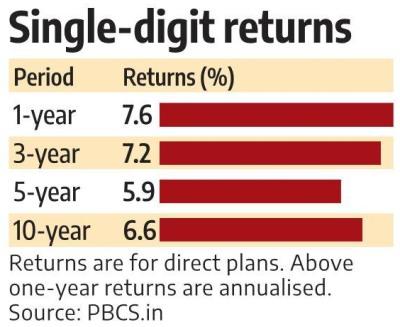
Some, though not high, risks
MMFs carry some, though not high, duration risk. "They can be slightly more volatile than liquid funds," says Sen.
Somani warns that investors must monitor portfolio quality and exposure to riskier instruments.
Shah adds that post-tax returns may not always keep pace with inflation, and net asset values (NAVs) can dip during mark-to-market or credit events, though good management reduces credit risk.
Don't enter with very short horizon
Investors should match their horizon with fund maturity. "They should avoid investing for very short periods, such as a fortnight to one month. These funds may show some volatility in the short term, especially during periods of sharp interest rate movements," says Sachin Jain, managing partner, Scripbox.
Sen suggests that investors may consider MMFs if their investment horizon is between six and 12 months.
Shah adds that these funds are an optimal solution for investors who may need access to quick cash or to park funds between investment decisions.
"Once investors have crossed the six- to seven-month period, their returns would be similar to those offered by fixed deposits. In addition, they would enjoy 100 per cent liquidity and similar taxation as FDs," says Jain.
Check portfolio quality
Begin by checking the asset management company's (AMC) track record and fund performance.
Next, examine portfolio quality. "Check the portion of the portfolio invested in A1+ holdings. Of the A1+ holdings, check how much is in treasury bills, CDs, and CPs. Treasury bills are the safest. Bank CDs are perceived as safer. In the case of CPs, the risk depends on the issuer. Check the issuer's credit rating and whether it is a blue-chip or an unknown company."
Average maturity also matters. "Different funds may have different average maturities, leading to variation in yield-to-maturity of 30 to 40 basis points," says Jain.
He advises comparing expense ratios and avoiding funds with very small assets under management (AUM).
Disclaimer: This article is meant for information purposes only. This article and information do not constitute a distribution, an endorsement, an investment advice, an offer to buy or sell or the solicitation of an offer to buy or sell any securities/schemes or any other financial products/investment products mentioned in this article to influence the opinion or behaviour of the investors/recipients.
Any use of the information/any investment and investment related decisions of the investors/recipients are at their sole discretion and risk. Any advice herein is made on a general basis and does not take into account the specific investment objectives of the specific person or group of persons. Opinions expressed herein are subject to change without notice.
Feature Presentation: Rajesh Alva/Rediff
