
Largecap equities are less volatile than mid- and smallcap stocks, making them suitable for risk-averse investors.
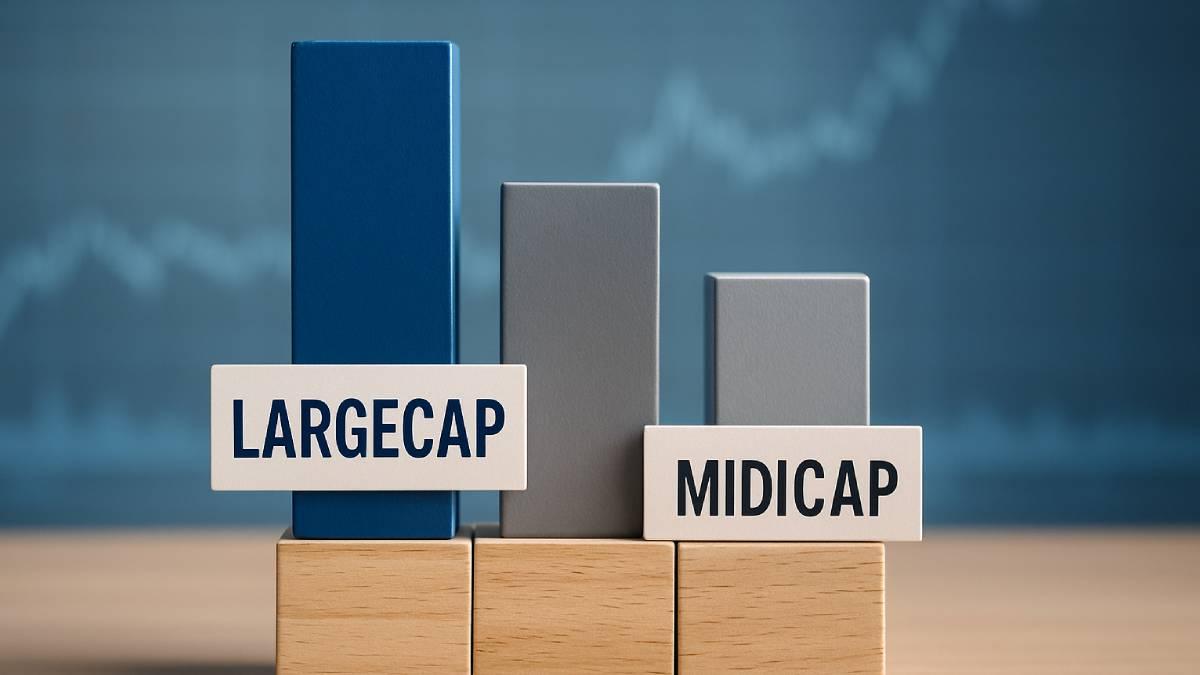
Largecap equity funds have delivered steady performance in the past year.
For the year ended November 18, 2025, they returned 9.2 per cent on average, compared to 8.6 per cent for midcap funds and 2.4 per cent for smallcap funds.
"Largecap funds provide stability, liquidity, and consistency -- three essential pillars of long-term wealth creation," says Sirshendu Basu, head – products, Bandhan Asset Management Company.
"These companies have proven track records, predictable earnings, and leadership positions in their respective industries. They should be permanent, core holdings in every investor’s equity portfolio," says Basu.
Despite this resilience, investor interest remains muted. According to data from the Association of Mutual Funds in India, largecap equity funds saw net inflows of Rs 971 crore in October 2025, the lowest since July 2024.
The creamy layer
Largecap funds invest a minimum of 80 per cent in the top 100 companies by market capitalisation.
Indices such as the Nifty 50, Nifty Next 50, and Nifty 100 track this segment. The Nifty 100 Index offers diversified exposure to 17 sectors.
Investors can choose from both active and passive largecap fund options.
Steady compounders
Largecap stocks are typically well-established names with a long-term track record.
Many have weathered tough phases in the economy in the past and have strong balance sheets, experienced management, and a strong governance framework.
"Large-cap funds are less prone to sharp market swings compared to mid- and smallcap funds and may offer comparatively steady performance over time, especially during economic downturns," says Abhinav Sharma, fund manager, Tata Asset Management.
"Stocks held by largecap funds are highly traded, making it easier to enter or exit positions," adds Sharma.
Value on offer
Experts say that valuations in the largecap segment remain appealing for long-term investors.
"Largecap stocks have undergone a healthy phase of consolidation and now appear fairly valued, offering selective opportunities for investors," says Sorbh Gupta, head – equity, Bajaj Finserv Asset Management.
"Importantly," explains Gupta, "earnings momentum for several largecap companies has begun to pick up, as reflected in the recent second-quarter results."
"Additionally, any reversal in foreign institutional investor flows could favour large caps, making them an attractive tactical allocation," adds Gupta.
Largecap equities are also less volatile than mid- and smallcap stocks, making them suitable for risk-averse investors.
Less scope for alpha
These stocks are widely researched by analysts and hence efficiently priced, leaving limited scope for fund managers to beat their benchmarks.
According to SPIVA (S&P Indices Versus Active) India's mid-year 2025 scorecard, 89.6 per cent of largecap funds underperformed the S&P India LargeMidcap Index over the five years ended June 30, 2025.
"In an economic up-cycle, where markets tend to be broad-based, largecap funds may give lower returns compared to small- or midcap funds," says Sharma.
Core portfolio role
Large caps should ideally form the core of individual investors' equity portfolios.
"Large-cap funds serve as the core of a balanced portfolio. While 40 to 60 per cent of the equity portion of a portfolio should be in largecap funds for balanced investors, conservative investors may go as high as 70 per cent, focusing on capital preservation and steady growth," says Basu.
"Aggressive investors can keep around 30 to 40 per cent in large caps, using the rest for higher-risk, higher-return segments like mid and small caps," adds Basu.
Investors should maintain a long-term view.
"An ideal holding period is generally seven years or more," says Gupta, "allowing the fund to ride through market cycles and capitalise on long-term growth."
Disclaimer: This article is meant for information purposes only. This article and information do not constitute a distribution, an endorsement, an investment advice, an offer to buy or sell or the solicitation of an offer to buy or sell any securities/schemes or any other financial products/investment products mentioned in this article to influence the opinion or behaviour of the investors/recipients.
Any use of the information/any investment and investment related decisions of the investors/recipients are at their sole discretion and risk. Any advice herein is made on a general basis and does not take into account the specific investment objectives of the specific person or group of persons. Opinions expressed herein are subject to change without notice.
Sarbajeet K Sen is a Gurugram-based independent journalist
