
'...than by the calendar.'
Indian travellers are no longer restricting their getaways to summer or winter holidays.
The traditional concept of the 'off-season' is rapidly becoming obsolete, as Indian travellers are no longer restricting their getaways to summer or winter holidays.
Instead, they are seizing every opportunity -- weekends, long breaks, and even workcations -- to pack their bags and travel.
Long weekends spread across the year, Gen Z seeking spontaneous experiences, and hybrid work flexibility are driving this shift to such an extent that destinations once considered seasonal like Goa, Corbett, Ooty, Dharamshala, Haridwar and Manali.
"While the Goan off-season typically begins from April 1 and goes on till October 31, we have started to see a lot of monsoon travellers including families, individual travellers who are just looking to catch a break and relax," said Sourav Panchanan, general manager at the Caravela beach resort in South Goa.
Rains or not, the 195-key resort has seen occupancy rates rising, contributed by MICE events and even weddings from April to June.
In FY24, the hotel clocked an average occupancy of 83.8 per cent versus 72 per cent in 2023.
Industry executives note that the pricing gap of hotel rooms as well as air tickets between peak and off-peak seasons has
narrowed, which was also contributing to this trend.
"Destinations traditionally considered off-season are now maintaining healthy occupancy levels of around 60 to 75 per cent, a marked increase from pre-pandemic averages of 40 to 50 per cent," Sabina Chopra, chief operating officer and cofounder at Yatra Online told Business Standard.
"This shift reflects the changing travel mindset and broader acceptance of travel beyond traditional peak windows," Chopra added.
"There is certainly a narrowing of the pricing gap between peak and off-peak seasons in many cases," said Karan Agarwal, director, Cox and Kings.
"Airlines and hotels have become far more dynamic in their pricing, with rates changing in real-time based on demand patterns, events, and even social trends.
"During what was traditionally considered off-season, you may still find premium pricing for popular long weekends, festivals, or trending destinations," Agarwal added.
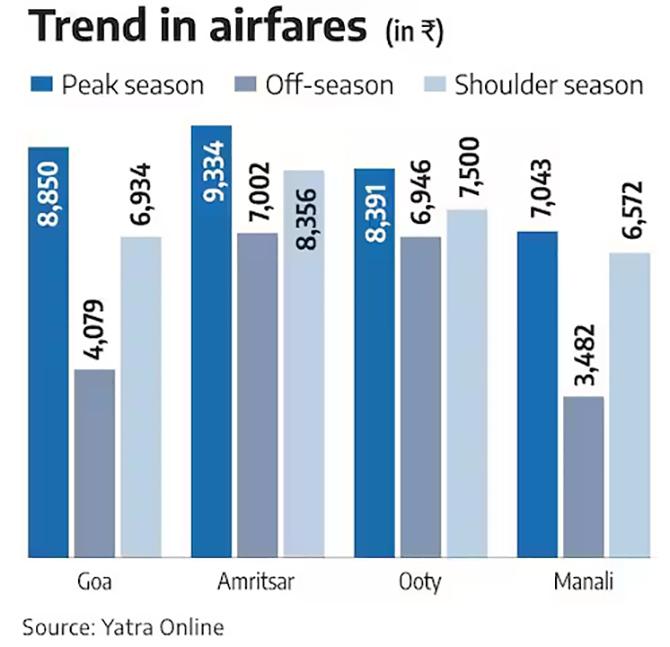
Now, however, shoulder seasons just before or after peak months are seeing more competitive pricing and attracting value-conscious travellers.
"At ITC Hotels, we have seen destinations once considered seasonal -- such as Dharamshala, Manali, Mussoorie, Chail, among others -- transform into year-round favourites. Today's traveller is driven more by moods and moments than by the calendar.
"This shift is being fuelled by evolving guest preferences and a desire for experiential, purpose-led stays.
"Factors like the rise of experiential travel, work-from-home flexibility, and the demand for short, immersive getaways have contributed to making several destinations attractive throughout the year," said Anil Chadha, managing director at ITC Hotels, told Business Standard.
The new-age traveller values both convenience and comfort, and in many cases time away from the crowded tourist spots, which is also driving demand in the non-peak seasons.
"Ultimately, India is evolving into a 12-month tourism market.
"As quality infrastructure improves and experiences diversify, the lines between peak and off-season will continue to blur," said Ravi Gosain, president of the Indian Association of Tour Operators.
Even spiritual hubs like Varanasi are evolving into year-round destinations, said Manjari Singhal, chief growth and business officer at Cleartrip, adding that metro cities have also emerged as popular staycation spots.
In the north, Corbett, a popular tourist destination, used to get impacted in the monsoon season as the national park partially shuts during the monsoon.
"While some zones in the Park close for the season, the Dhela and Jhirna safari zones remain open, offering wildlife experiences.
"During the off season too, we see guests staying for long periods, indulging themselves in nature, Avni Tripathi, director and chief marketing officer at Aahana Resort at Corbett.
"So, this season we're curating experiences: from yoga in the morning mist, to spa treatments with the rain as soundtrack, and creative weekends featuring pottery and moments of meditative stillness," Tripahti added.
Not just a new work culture, but infrastructural development including better road connectivity for short-haul destinations and a higher number of airports for the not-so-close destinations, is also aiding this evolution.
"Better roads, air connectivity, and the growth of high-quality hotels, resorts, and homestays even in Tier-II and Tier-III towns have made travel more accessible and comfortable in all seasons," said Ved Khanna, board member at the Federation of Associations in Indian Tourism and Hospitality.
Jatin Khanna, chief executive officer at Sarovar Hotels concurs.
"Today, there is no true 'off-season', thanks to a mix of improved infrastructure, evolving traveller preferences, and a strong surge in domestic demand.
"Enhanced highway networks, new regional airports, and better last-mile connectivity have made travel easier and more seamless across the country," he said.
"Short-haul getaways have become increasingly popular, and cities like Goa, Amritsar, Lucknow, and Haridwar are now all-season destinations," he added.
Feature Presentation: Ashish Narsale/Rediff
