A blunt message from Apple's CEO...
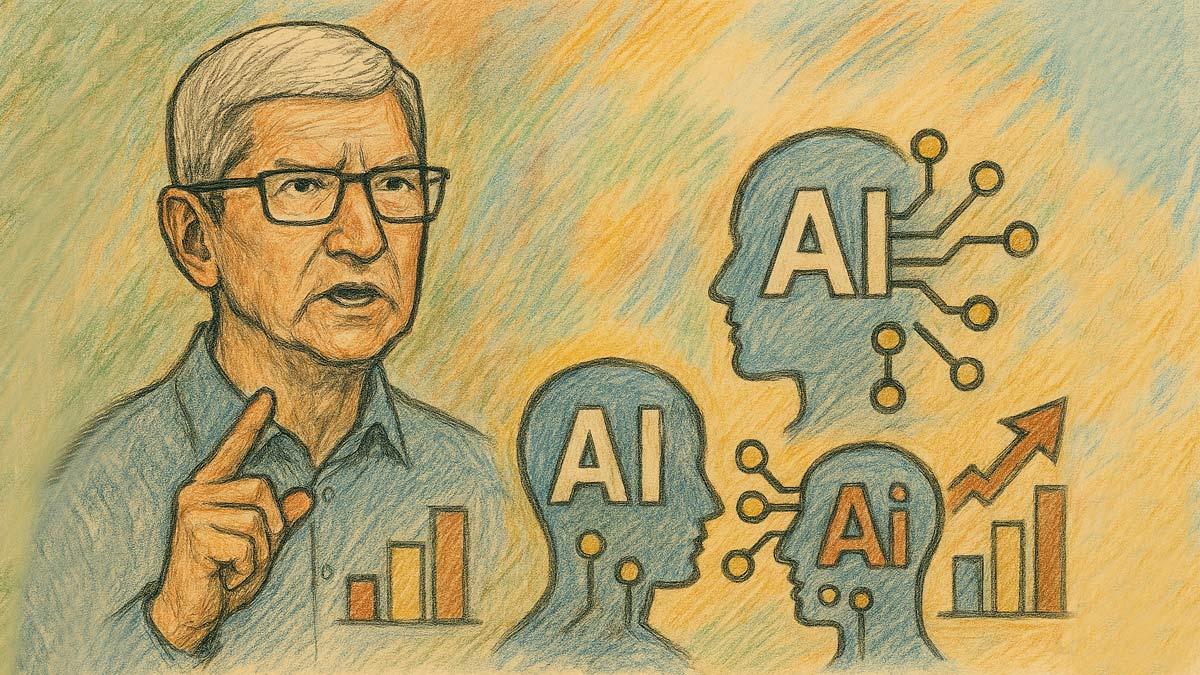
Artificial intelligence is no longer a distant future technology; it is a force reshaping industries in real time. That was the blunt message from Apple CEO Tim Cook, who recently told employees that failing to embrace AI could mean being left behind.
Speaking at an internal town hall at Apple's Cupertino headquarters recently, Cook urged staff to see artificial intelligence as a defining shift, one comparable to -- and possibly greater than -- the rise of the Internet.
'To not use AI would be to be left behind and we cannot allow that,' he said, according to reports published by Bloomberg and subsequently carried by media outlets worldwide.
His remarks, though aimed at Apple employees, carry resonance well beyond Silicon Valley. For students preparing to enter the workforce, professionals navigating mid-career shifts and companies seeking competitiveness, the message is clear: Artificial intelligence is becoming a foundational skill and strategic tool across all sectors.
Apple's high-stakes AI gamble
Cook's warning comes as Apple ramps up efforts to catch up with rivals in the artificial intelligence race. The company, long admired for its cautious approach to new technologies, has been facing increasing pressure from investors and analysts to deliver a credible AI roadmap.
In recent months, Apple has reportedly added around 12,000 new employees, with nearly 40 per cent devoted to research and development, much of it centred on AI.
Engineers are said to be working on a redesigned server architecture, new custom chips known internally as Baltra and a major overhaul of Siri. These moves are designed to give Apple the infrastructure to power its new initiative, branded Apple Intelligence.
According to TechRadar, Cook used the meeting to rally staff, telling them: 'Apple must do this. Apple will do this. This is ours to grab.'
The motivational tone was matched with an acknowledgement of recent setbacks, including delays in rolling out AI features across devices.
A broader message for workers and students
Although Cook's comments were directed at Apple's global workforce, education analysts note that they also serve as guidelines for students and young professionals. In a report carried by The Times Of India, Cook's message was reframed as a career imperative: Those entering the job market must acquire AI literacy if they wish to remain competitive.
Employers across industries -- from healthcare to finance, design to customer service -- are increasingly expecting candidates to demonstrate familiarity with AI tools.
Recruiters say that proficiency in data analysis, automation platforms or AI-assisted design software is rapidly shifting from being a 'bonus' skill to a baseline expectation.
Career experts add that Cook's warning underscores a broader trend: The nature of work is being redefined. Routine, repetitive tasks are most at risk of being automated, while creativity, judgement, empathy and problem-solving -- qualities uniquely human -- are becoming more valuable.
Balancing technology with human values
At the same time, Cook reiterated Apple's long-standing emphasis on privacy and human-centred design. Unlike some competitors that have pushed AI systems into the market quickly, Apple has sought to integrate safeguards and ensure that user data is not compromised.
Analysts say this strategy reflects Apple's broader brand identity: A company that sells trust as much as technology. But critics argue that caution has cost Apple valuable time in a field where rivals like Microsoft, Google and OpenAI are moving at speed.
Lessons for the wider workforce
For employees and students outside of Apple, the lessons from Cook's remarks are equally stark. Career coaches emphasise three key takeaways:
1. AI fluency is essential: Just as digital literacy became a baseline requirement in the 2000s, AI literacy is now a must-have skill. Understanding how to use AI tools to streamline work will soon be as fundamental as knowing how to use e-mail or spreadsheets.
2. Human skills matter more: As machines take on repetitive tasks, human abilities such as leadership, ethical reasoning and creative problem-solving will grow in importance.
Cook's emphasis on a human-centred approach signals that technology should enhance, not replace, human judgement.
3. Adaptability is key: Technology will continue to evolve, often unpredictably. The professionals most likely to thrive will be those who can adapt quickly, learn continuously and embrace change rather than resist it.
Cook's rallying cry is part of Apple's attempt to reposition itself in the AI era. But it also mirrors a broader truth: Artificial intelligence is no longer a peripheral tool, it is becoming central to how work is organised, value is created and careers are shaped.
For Apple, embracing AI is about retaining its competitive edge in a fiercely contested market. For individuals, it is about ensuring employability and relevance in a rapidly changing economy.
As Cook put it to his staff, the choice is stark: Adopt AI or risk being left behind. The same applies to everyone preparing for the future of work.