Indian graduates face tougher English tests, shorter post-study stays, higher costs and stricter settlement rules as Britain rolls out sweeping immigration reforms.
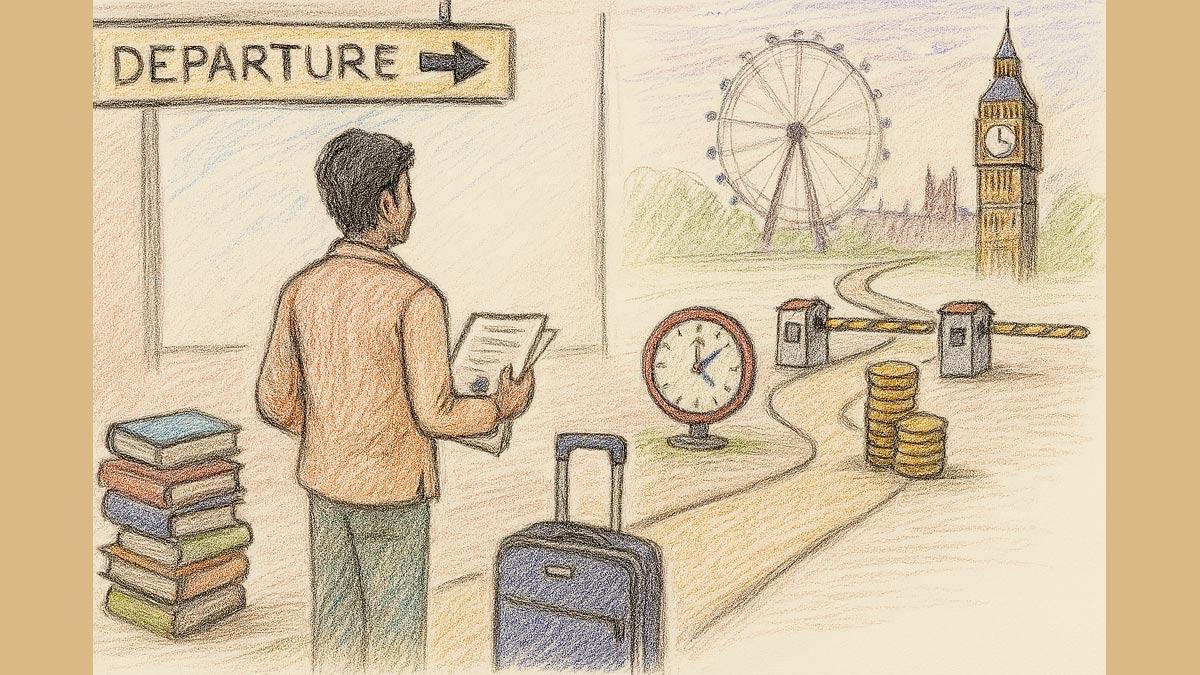
From 2026, Indian aspirants must clear B2-level English tests, while graduate visas will shrink to 18 months from 2027.
Higher financial proof, steeper employer charges and stricter settlement timelines add to the pressure, with the UK government insisting the measures will 'restore control' over migration.
Indian students and professionals eyeing a future in the UK will face sweeping new visa restrictions that tighten entry, raise costs and shorten opportunities to stay on after study.
The measures, announced in the government's immigration white paper, Restoring Control over the Immigration System (external link) and debated in parliament this week, are designed to bring down net migration.
Britain recorded a peak of 906,000 in 2023, prompting political pressure for tougher rules.
English test tougher from 2026
From January 8, 2026, all applicants for skilled worker, high potential individual (HPI) and scale-up visas must pass a Secure English Language Test (SELT) at the B2 level, equivalent to India's class 12/A level.
The home office said the higher bar, which will replace the current B1 standard, will ensure migrants are 'better able to integrate into life in the UK'. The test must be taken with an approved provider, with results verified during visa processing.
UK's Home Secretary Shabana Mahmood told MPs, 'If you come to this country, you must learn our language and play your part.'
Graduate visas cut to 18 months
From January 1, 2027, graduate route visas -- popular among Indian students -- will shrink from two years to 18 months, though PhD graduates will retain a three-year allowance.
UK's Home Office Minister Mike Tapp said, 'Too many graduates are not progressing into graduate-level employment. This change will ensure those who remain transition into graduate-level jobs and properly contribute to the UK economy.'
With many medium-skilled roles already removed from the skilled worker occupation list in July 2025, Indian students face a tighter timeline and fewer pathways to remain after studies.
Higher costs for students and employers
For the 2025-26 academic year, foreign students must show increased maintenance funds: £1,529 (approximately Rs 1,60,545) per month, up from £1,483 (approximately Rs 1,55,715) and £1,171 (approximately Rs 1,22,955) per month, up from £1,136 (≈ Rs 1,19,280).
Employers hiring foreign workers will also shoulder higher costs.
The immigration skills charge (ISC) will rise 32 per cent -- to £480 (approximately Rs 50,400) per worker per year for small firms and £1,320 (approximately Rs 1,38,600) per worker per year for large companies.
The home office said the increase, the first since 2017, will 'boost investment in British workers and reduce reliance on overseas recruitment'.
Settlement may take longer
The Commons Library briefing (external link) also revealed that the qualifying period for indefinite leave to remain (ILR) could be extended from the current five years to 10 years for most migrants.
Only those deemed to make a higher contribution would benefit from shorter settlement routes.
For Indians aiming for permanent residence, this means a longer, costlier road to stability.
Expanding high-talent routes
The government will also:
• Double the number of universities eligible for the HPI route, while capping seats at 8,000 per year. Intake will rise from 2,000 to 4,000.
• Expand the global talent route in 2026 to attract top researchers, designers and creatives.
• Ease the transition from a student visa to the innovator founder visa for entrepreneurs, enabling graduates to establish businesses in Britain.
Before vs after: What Indian aspirants must know
|
Category |
Current Rules |
New Rules (Effective Date) |
Impact on Indians |
|
English Test |
B1 for skilled workers, HPI, scale-up |
B2 SELT (A-Level/Class 12) from Jan 8, 2026 |
Tougher exam, more prep needed |
|
Graduate route visa |
2 years (master's), 3 years (PhD) |
18 months (master's) from Jan 1, 2027; PhD stays at three years |
Less time to secure jobs |
|
Student visa funds |
£1,483/month, London; £1,136 rest |
£1,529, London; £1,171 for the rest of UK from 2025-26 |
Higher financial burden |
|
Employer ISC levy |
£364 (small); £1,000 (large) |
£480 (small); £1,320 (large) |
Costlier to hire Indians |
|
Skilled worker jobs |
Wider list pre-July 2025 |
Fewer job roles eligible after July 22, 2025 |
Harder switch from Graduate → Skilled Worker |
| Settlement ILR |
Usually five years |
Likely 10 years for most routes |
Longer wait for residency |
|
HPI route |
Approximately 2,000 visas/year |
Cap at 8,000 student seats, intake will increase to 4,000, double the number of universities eligible for the HPI route |
More Indians may qualify |
|
Global talent |
Narrow scope |
The global talent route will be expanded in 2026 |
Wider access for top talent |
|
Entrepreneur path |
Complicated |
Easier for students who become innovators |
Smoother for Indian start-ups |
The bottom line
For Indian graduates, the message is clear: Be prepared for tougher language tests, higher upfront financials and stricter timelines to secure skilled work.
Long-term settlement may also take longer.
The UK insists the changes will keep routes open to talent but in a 'controlled, selective and fair' manner.