Generative AI is transforming workplaces but at a cost -- there are fewer jobs for young workers just entering the workforce, reveals a Goldman Sachs report.
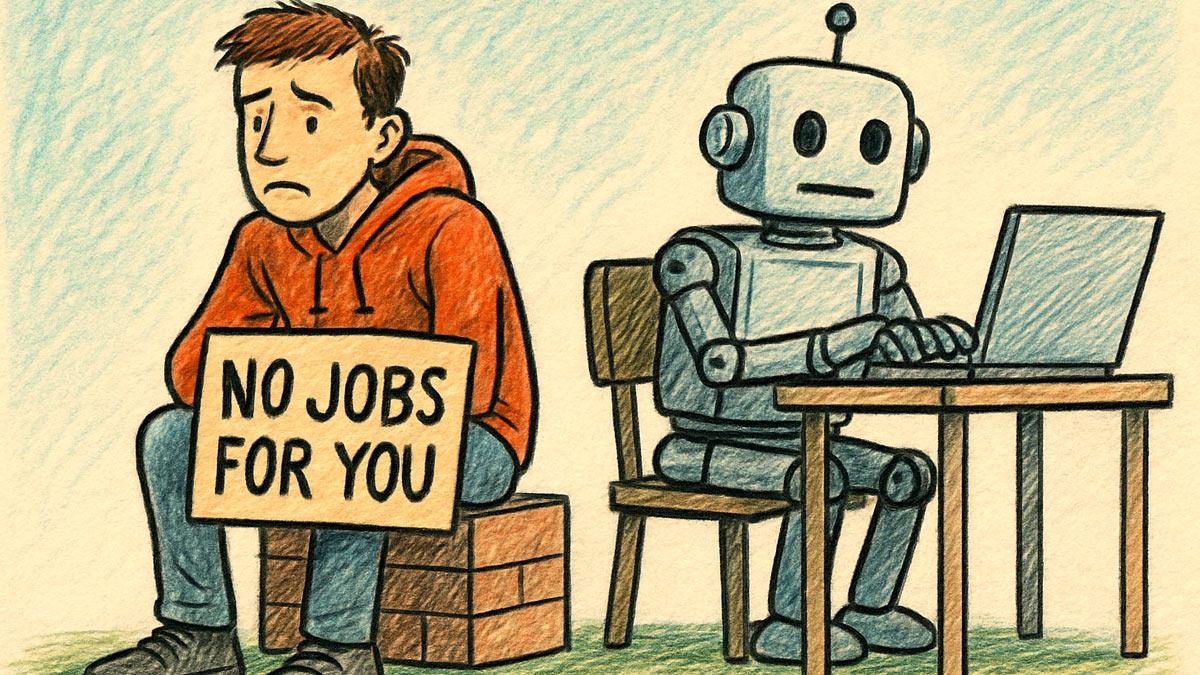
The rise of artificial intelligence is reshaping the global labour market but not in the way many young workers had hoped.
A recent analysis by Goldman Sachs has raised red flags over a worrying trend: Job creation is lagging behind among younger demographics, especially in the United States, as companies adopt generative AI tools at an accelerated pace.
According to the financial giant, the proportion of employed 15 to 24 year olds in the US has dropped significantly since the pandemic, falling by nearly four percentage points compared to pre-Covid levels.
This decline is in stark contrast to employment among older age groups, which has largely recovered or even surpassed pre-2020 numbers.
The culprit, Goldman Sachs suggests, is the AI-powered automation of entry-level white-collar jobs -- particularly in clerical, administrative, and support roles -- once considered reliable stepping stones for young professionals.
As generative AI systems like ChatGPT, Google Gemini and Microsoft Copilot become more prevalent across industries, the demand for early-career employees to perform basic cognitive tasks is diminishing.
The invisible layoffs
While the headlines may focus on tech industry layoffs or hiring freezes, the bigger shift may be occurring silently.
Entry-level jobs are quietly disappearing. 'It's not that these jobs are being taken away from existing employees,' says Jan Hatzius, Chief Economist, Goldman Sachs. 'It's that they are not being created in the first place.'
The pandemic accelerated digital transformation across businesses. Remote work, cloud computing and AI adoption surged. Now, firms are reaping productivity gains by turning to algorithms to manage scheduling, data entry, customer service and more.
This digital-first approach is hitting young jobseekers the hardest -- especially those without advanced degrees or niche technical skills.
According to a report by the McKinsey Global Institute, nearly 12 million Americans may need to switch occupations by 2030 due to AI and automation.
The bulk of these transitions will affect office support, customer service and food service workers -- sectors where young workers have historically found their first jobs.
A global echo
The phenomenon isn't confined to the United States.
In the United Kingdom, the Office for National Statistics data shows that employment rates among young adults aged 16 to 24 have yet to return to pre-pandemic levels.
The Institute for Public Policy Research warns that the 'quality and quantity of entry-level jobs are under threat', as AI systems begin handling tasks ranging from document summarisation to basic legal research.
In India, where over 65 per cent of the population is under the age of 35, the implications are even more severe.
According to the Centre for Monitoring Indian Economy (CMIE) data, youth unemployment in urban India hovered around 17 per cent in early 2025, much higher than the overall jobless rate.
Economists warn that the influx of educated yet under-employed graduates is becoming a structural challenge.
A NASSCOM-KPMG report on AI in India noted that while AI adoption is driving efficiency, 'there is limited evidence of widespread job creation to offset displacement in the short term'. Most of the newly created roles require specialised AI or data science skills -- qualifications that many young jobseekers lack.
AI's productivity vs employment dilemma
The paradox of AI lies in its promise: greater productivity, better decision-making and cost savings. Yet, as machines take on more routine tasks, the human roles they replace are not necessarily being reimagined or redeployed.
'Historically, every major technological shift has eventually led to net job creation,' notes Professor Erik Brynjolfsson of Stanford University. 'But the transition is always disruptive and those caught in the early stages -- particularly the young -- bear the brunt of it.'
Goldman Sachs estimates that AI could boost global GDP by seven per cent over the next decade. However, these gains may be unevenly distributed, with older, more experienced workers who complement AI benefitting more than younger workers who often compete with it.
The risk is a widening generation gap in employment outcomes.
While senior roles involving strategic decision-making, interpersonal skills and complex judgement remain secure or even in demand, entry-level roles are becoming scarcer.
India's ministry of electronics and IT is exploring frameworks to support reskilling for AI-driven industries.
But implementation remains slow and the pace of AI adoption shows no signs of easing.
For young workers, the path ahead demands agility.
'Degrees alone won't cut it anymore,' says Devika Chatterjee, a Mumbai-based career counsellor. 'What employers want now are adaptive learners -- people who can work alongside machines, not be replaced by them.'
Experts suggest early exposure to AI tools, coding and digital workflows should begin in secondary school. Internships and apprenticeships may need to evolve to offer hands-on experience with AI-assisted environments rather than purely manual processes.
Ultimately, the transition to an AI-driven economy must not come at the cost of a lost generation of workers.
As Goldman Sachs warns, the erosion of entry-level jobs is not just a labour market story -- it's a social and economic warning sign.
'We are facing a structural transformation,' Hatzius concludes. 'Without the right guardrails and investments, we risk sidelining the very generation meant to drive the future.'