
Efforts are underway to integrate AI education into all degree programmes -- including BA, BCom, BSc, and specialised courses.
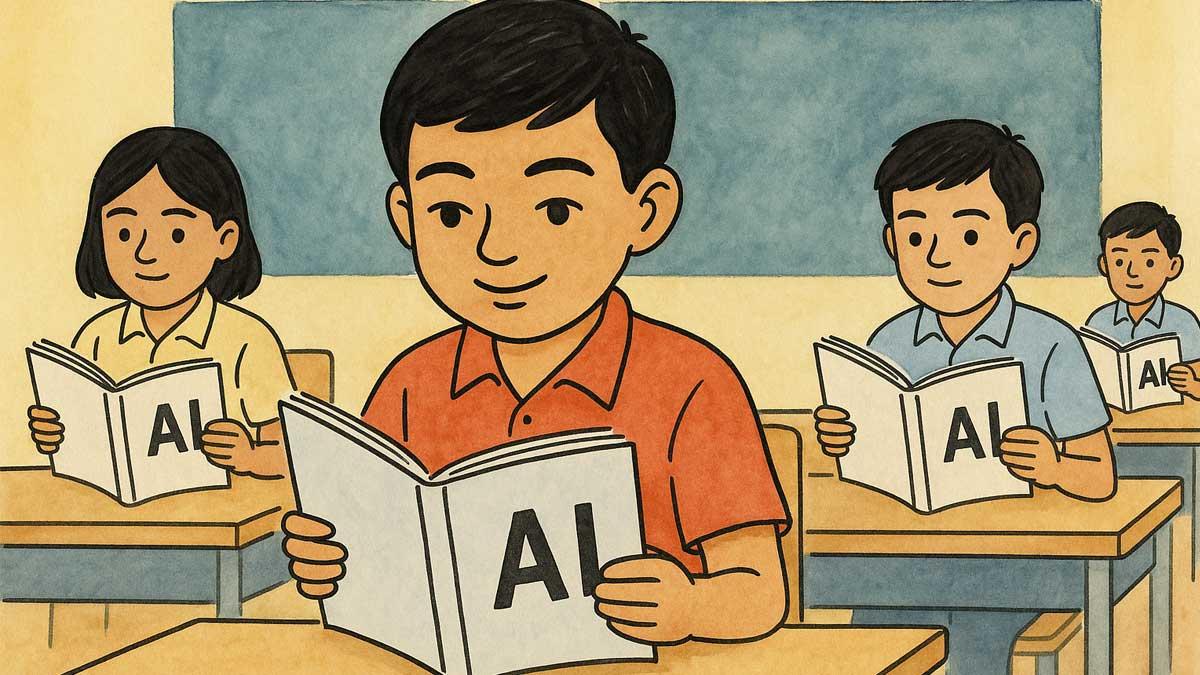
Come April 2026, Class-III students in around 31,000 Indian schools will see new additions to their syllabus, including foundational-level mathematics and language skills.
Along with learning subtraction, multiplication, division, reading comprehension, grammar, and sentence construction, they will also be introduced to language models, chatbot prompts, and generative artificial intelligence (AI).
Separately, efforts are underway to integrate AI education into all degree programmes -- including BA, BCom, BSc, and specialised courses -- to ensure that such blended curricula prepare Indian students for new job roles emerging in an AI-driven workforce landscape.
These two parallel initiatives in the education sector come at a time when anxiety over AI is reshaping the job market, especially for the roughly 8 million Indians employed in the technology sector.
China integrated AI into its high-school curriculum in 2022, while several states in the United States have introduced AI education from kindergarten to Class 12.
"We need to introduce AI in our school curriculum at the earliest. The Central Board of Secondary Education (CBSE) is working on it, and we have set a deadline of April 2026, when the new academic session begins, to introduce AI in the curriculum from Class-III onwards," said Sanjay Kumar, secretary, Department of School Education and Literacy, ministry of education.
Addressing concerns over AI-driven job losses, Kumar said such fears surfaced repeatedly throughout history, yet humanity always adapted and emerged stronger.
"Many people tell me that AI is something very different -- unlike anything we have seen before. But I do not think so.
"My main concern is ensuring that everyone understands AI, because once people know it, they will find a way to adapt," he said at an event where the NITI Aayog unveiled a Road Map for Job Creation in the AI Economy.
Kumar sought inputs from the Centre's think-tank and industry body Nasscom to design an effective and practical AI curriculum that teachers could be trained to deliver.
"We need to reach out to teachers -- India has over 10 million of them. How do we orient them and ensure they understand AI," he asked.
Higher Education Secretary Vineet Joshi noted that while countries like the US updated their curricula every few months, India's more than 1,200 universities designed their own programmes, making it necessary to introduce reforms across the board.
"Every university is responsible for its own curriculum, and each follows its own process.
"We must reach out to them with a sense of urgency -- time is running out, and we need to move quickly.
"A large number of new roles are emerging, and to prepare students for them, we must rethink our general education structure.
"We need to examine what changes are required in programmes such as BA, BSc, and BCom -- and do so without delay," Joshi said.
The 50,000 Atal Tinkering Labs (ATLs) being set up under the Atal Innovation Mission, Kumar said, would offer another opportunity for secondary school students to gain practical, hands-on experience with AI.
"Almost every student in our secondary and higher secondary schools will have access to an ATL.
"If we can introduce AI in a significant way across all these labs, it will help familiarise every secondary school student with what AI is and the possibilities it offers," he said.
Emphasising the need for swift action, Kumar said if students learn about AI early in school and the technology becomes more democratised through wider access, "we will be able to manage the technology better".
Feature Presentation: Ashish Narsale/Rediff
