STEP VII: Take the tests
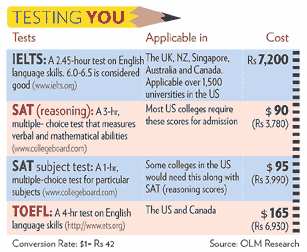
You should have started preparing for the tests you need to take about the time you started your research. Now that you know what you are applying for, it is time to take the tests. You would almost certainly need an English language proficiency test, International English Language Testing System (IELTS) or Test of English as a Foreign Language (TOEFL). An IELTS score is mandatory to apply for an Australian visa.
Chennai's Shashidhar Nambiar, director, IMTP Consultancy Services, a Chennai-based education advisory, explains: "You first get a conditional offer from the university. Based on your marks in English in Class XII (at least 80 per cent), it may waive your test requirement and send you an acceptance letter or wait to do so till they get your score. Either way, they will let you know if you need to take a test."
In addition, US universities would require the score of the Scholastic Aptitude Test (SAT) of reasoning while some would also ask for the SAT subject test score (see Testing You).
STEP VIII: Organise the funds
Self-funding or sponsorship. This is often the key since you will likely pay for yourself. "The student's parents or sponsor needs to prepare 6-9 months in advance. Ready funds (liquid assets) should ideally be 6-8 months old at the time of applying for a visa.
"Recent transfers of large amounts must be explained with documentary proof of source," says Sunil Sukhwani, director, Edwise, a Mumbai-based overseas education consultancy. Sircar is against going on a shoestring and advises deferring plans if there is a financial problem. You need to show proof of assets for the first year of study and plans for the subsequent years. Australia, however, needs proof for the entire course duration.
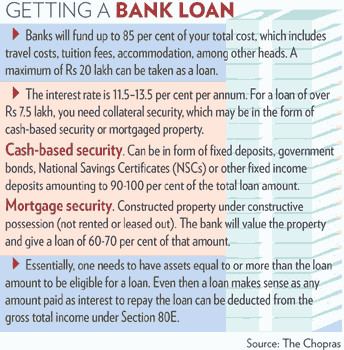
Loans. Banks give loans for studying abroad, but only for professional or job-oriented courses. You would have to give an assessment of future income at the time of borrowing and start repaying six months after the course ends. This may not work if you are are going for higher studies.
While loans up to Rs 20 lakh are available, collateral is needed for loans above Rs 7.50 lakh. Maheswari got a Rs 20-lakh loan from Allahabad Bank for his Bachelor's course. He, however, had the advantage that his father was with the bank for the previous 30 years. (see Getting A Bank Loan)
Powered by 
Also see: Students: 10 things to know before you fly abroad
 Advertisement