STEP III: Get guidance
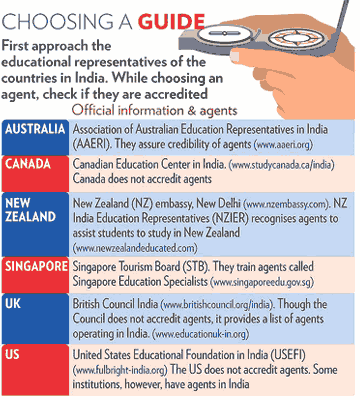
The next place to go to would be the official educational representatives of the countries in India. (see Choosing A Guide)
Alongside, you can take help from agents and/or educational counsellors, who can guide you throughout the entire process. Sircar advises caution here: "Check if the counsellor is an approved agent. You can even check with the colleges concerned. Do a background check. You can also tap into alumni networks and contact Indian students who have used an agent to get recommendations."
Arindam Mukherjee, eastern region development officer for The Chopras warns of consultants who represent a few universities and hardsell them and also of those who assure you a visa. The latter may often be frauds. Word of mouth is usually reliable. Hakak went to The Chopras, as his cousin had before him.
Charges. The services of the official representatives are mostly free. Agents, however, make money from commissions from colleges and service fees from students. Some take a refundable deposit that you lose if you do not take admission through them. US universities don’t give agents a cut, so counsellors often charge a package fee for five to six universities. You can budget for around Rs 10,000 for these services, says Sircar.
STEP IV: Pick the place
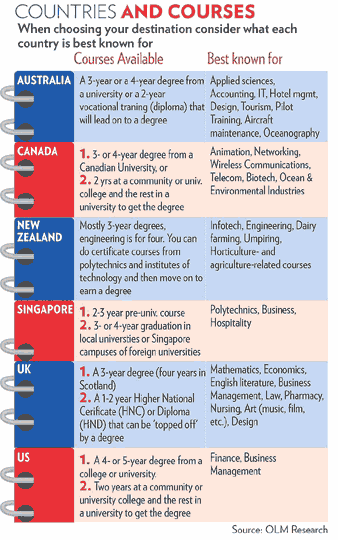
This is a bit tricky. Ideally, this should depend on where the best course in your field is offered (see Countries and Courses). Singh, who also wears the hat of the president of the Association of Australian Representatives in India (AAERI), says: "While the US is known for research, the UK scores in pure studies, and Australia in applied sciences and vocational courses."
Bhaskar Maheswari, 23, who did his Bachelors in Business Administration and HR management from Keene University, UK, says, "The UK is one of the best places for management education; you get exposure to an economically advanced business environment."
Costs. Herein comes the question of what you are comfortable spending since you are likely to be paying your way through. Course fees and living expenses vary across countries. Often, the duration of course will be determined by the country you are going to. The longer it is, the higher the costs. So do the maths before you choose (see Costs Matter).
Part-time work. Typically, if you are borrowing to finance your studies, you would want to earn to keep your liabilities down. You might even want some cash in hand to live a little better. Pachisia, for instance, works as a computer lab assistant for $10-11 an hour but he cannot manage all the 20 hours allowed per week because of semester timings (see Work Wise).
Working after graduation. International job exposure looks good on a CV in today's globalised environment. If this is priority, your course should be in a country that allows you to stay on. "New Zealand is the best place for this," says Mukherjee. Australia, too, welcomes foreign students. Says Singh, "The permanent residence application system is very transparent." The US and the UK are a bit stuffy in this respect. "If you are planning to stay on in the UK, you are barking up the wrong tree, the route is tedious," says Rao (see Striking Roots).
Location. Bhaskar chose Keene because he is not "a city person and wanted to experience the traditional English life." If you have such preferences, factor them in too.
Powered by 
Also see: 'New Zealand is an emerging market'
 Advertisement