
Zomato was not just recovering, it was rebuilding and reinventing, showing signs of maturing as a business. Chaos had been turned into momentum.
A fascinating excerpt from Megha Vishwanath's book, UNSEEN: The Untold Story of Deepinder Goyal And The Making Of Zomato.
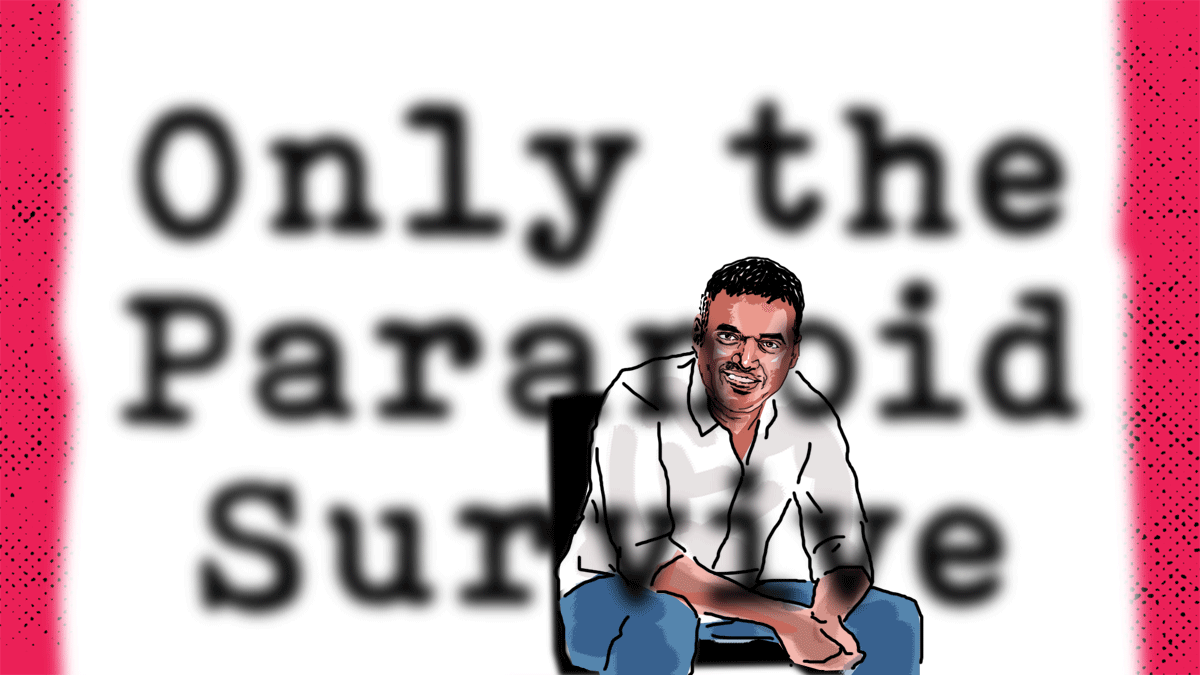
On a cold winter morning in December 2022, only a few months after the Blinkit acquisition, the Zomato team had started losing market share to Swiggy, and Blinkit was still burning cash with no road to profitability in sight. The stock price was still awfully low.
At 8 am in the morning, Deepinder Goyal was the first one to enter the office. Looming over Deepinder's workstation was an unmissable cue, a giant poster that read: Only the Paranoid Survive.
This wasn't just office decor. It was a battle cry.
On his desk sat a closed MacBook. And next to it, bound with a rubber band, a small bunch of handwritten flash cards.
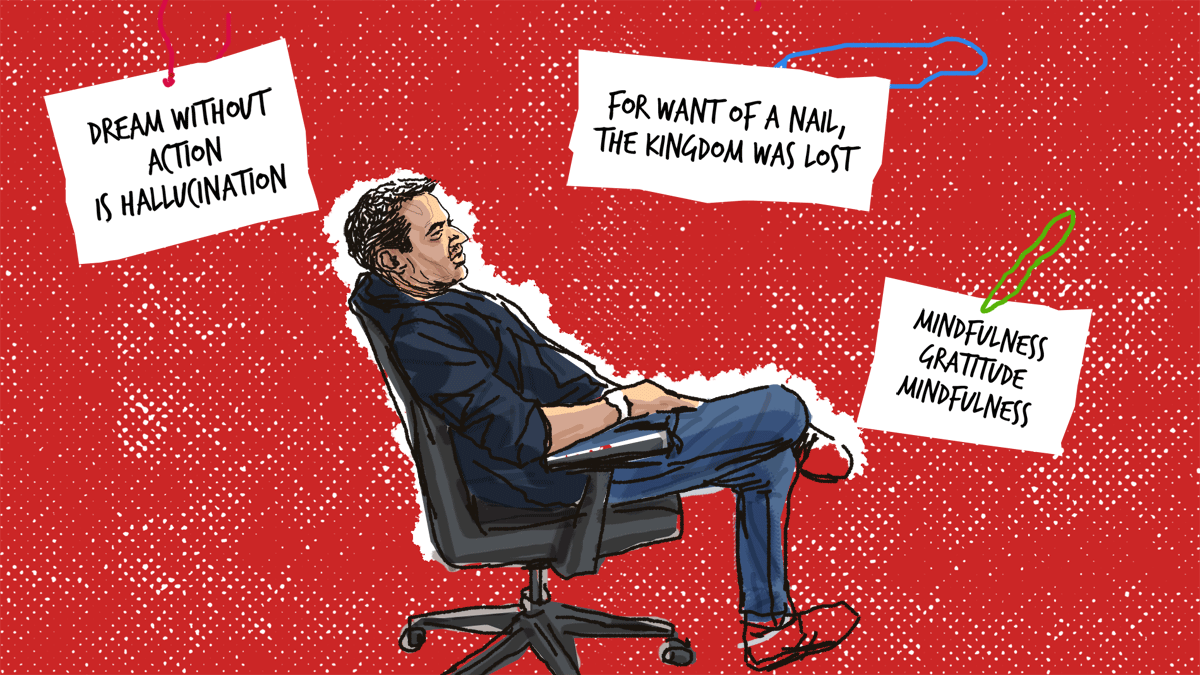
Card one: Mindfulness ←→ Gratitude ←→ Mindfulness
Card two: Dream without action is hallucination
Flipped to the next card.
These evolving set of flash cards acted as daily reminders for himself. Scribbled, revised and revisited over the years.
They were not mantras in the traditional sense, but he saw these more like prompts, self-created nudges to stay awake, stay honest and rewire his subconscious until the flash card was no longer needed.
Finally, he flipped to the third card: For want of a nail, the kingdom was lost.
He paused here as these words stuck.
The last flash card was a reminder of how seemingly minor issues can spiral into existential risks for a business. Be it ignored bugs in the product, small cracks in execution or, most importantly, unchecked egos.
One missed nail. One lost kingdom.
At the time, Deepinder felt there were missing nails everywhere.
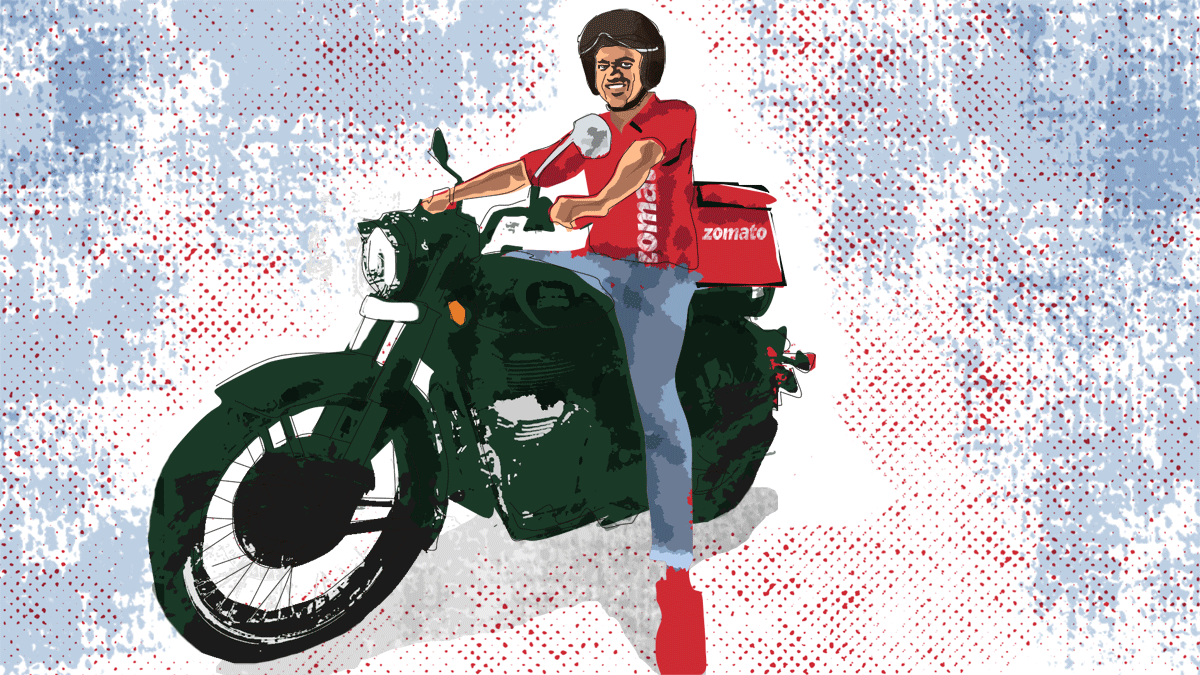
A few weeks ago, he had begun anticipating a crisis of complacency when it came to the people in the organisation.
Many had made a lot of money during the IPO, and while all of them chose to stay back, he feared that they weren't really innovating, or pushing the company out of the danger zone.
Battle-hardened, Deepinder was convinced of one thing: Complacency was the enemy and paranoia was the only path to survival.
Deepinder had learnt a key lesson in his journey of entrepreneurship. Success was deceptive and fragile; it could crumble in an instant. The moment you celebrated, it slipped through your fingers.
It was during this time Deepinder entered a phase that he would later describe as the most intense working period of his life.
He was clocking sixteen-hour days, seven days a week, often even more. He was the first to arrive at the office and the last to leave.
Passion, at its most extreme, comes at a cost. 'Everyone wants to be successful, but few are willing to make the sacrifices it takes. To build something truly transformative, one must be willing to set aside personal and emotional comforts.'
Deepinder had made plenty of sacrifices in his own life but he never saw it that way. 'Some might say I failed at maintaining a work-life balance. But I don’t feel like I’ve made any sacrifices while building Zomato.’
Most of his days during this time ran with machine-like precision and each meeting was capped at fifteen minutes with a five-minute buffer on his calendar to reset, clear his mind and enter the next conversation with purpose.
Simrandeep Singh, his executive assistant at the time, recalled how at that point fifty teams or more were working directly with him.
But this wasn't top-down control, it was proximity. He listened, intently, especially when someone had an idea. And when something wasn't working, he rolled up his sleeves and fixed it, ground-up.
Deepinder was tackling two things at once at Zomato -- lagging profitability and slowing growth. He couldn't choose one over the other.
So, determined to solve for profitability and growth at the same time, Deepinder embraced the paradox and pursued both with equal.
By March 2023, the hard efforts began to show fruit. Zomato stock gained momentum, marking the beginning of an uptrend.
The business was beginning to show incremental improvement quarter on quarter. Blinkit was expanding aggressively, opening more dark stores at an unprecedented pace.
Investors could see something shifting.
The message was clear: Zomato was not just recovering, it was rebuilding and reinventing, showing signs of maturing as a business. Chaos had been turned into momentum.
Deepinder had always thrived in the unknown and this time, it was no different.
Just a few months later, in the quarter of April-June 2023, Zomato reported a profit of INR 2 crore. It came as a huge surprise to everyone, including people in the team.
At a town hall meeting, Deepinder stood before his team. Instead of waxing eloquent on their recent good showing, he grabbed a marker and scrawled a graph. He said two words: Time vs. Confidence
He began explaining, 'X axis is Time, and Y Axis is self confidence.'
He drew a line and a curve on a whiteboard in front of him. The first rising sharply before plunging into a deep valley and then rising again.
One, he labelled The Maverick Rise. The other, The Ascent of Greatness.
'When you start a company and taste early success,' he continued, 'your confidence skyrockets. You feel untouchable, like a maverick, like you are ahead of the game.'
He paused, tapping the peak of the curve. 'But then, one day, everything crashes. Reality punches you in the gut. Your confidence doesn't just dip, it free falls.'
Deepinder's hand-drawn Time vs Confidence graph
He drew his finger along the downward slope, stopping at the bottom. 'This,' he described, 'is no man's land. This is where it gets interesting. Because while this part feels like failure, it's actually where real learning begins. If you stay in the game, if you push through the doubt, this is where the journey to greatness starts.
'And as you traverse in your journey, if you think you are on the path to greatness, and you are 'great', you start behaving like a maverick again.
'The right place to stay is close to no man's land -- always in self-doubt, without crippling yourself with that self-doubt,' he concluded.

Most companies accidentally end up building cults of personality. Zomato was no different in the early days. And the problem with cults is, when the central figure steps back, even for a brief period, the system begins to wobble. Deepinder realized that.
That's why, at Zomato, he made the radical choice of introducing the concept of 'rotational leadership'. This model redefined how power is held and eventually handed over.
It was not just a reshuffling of job titles. It defined the concept of elevations or promotions. It was an intentional design where leaders were on the clock.
You lead today, step aside tomorrow and support the next in line after that.
This way no one person holds the keys forever. It encouraged the culture of passing on the baton, breaking hierarchies and normalizing the act of letting go.
At Zomato, leadership is leased, never owned. Every new c-suite executive knew their time was finite and Deepinder believed this model allowed people to lead differently, more urgently and definitely more generously.
Rotational leadership taught the teams at Zomato to build for continuity, not dependency. It helped them scale beyond one person’s genius. It also kept egos in check.
Deepinder also insisted that no one in the senior team receive cash bonuses. He simply did not believe in the if-then philosophy of rewards.
To him, the idea that you reward someone with a set bonus if they hit a predefined milestone was absurd.
Instead, he leaned into a now-that approach: Now that you've created something meaningful, driven impact or solved something hard, here's your reward.
There was no checklist or tangible targets one needed to hit, just outcomes that matter.
Excerpted from UNSEEN: The Untold Story of Deepinder Goyal And The Making Of Zomato, by Megha Vishwanath, with the kind permission of the publishers, Penguin India.
Feature Presentation: Rajesh Alva/Rediff