While TCS cited evolving business needs and future readiness as reasons, industry experts say the action is a cost-cutting measure aimed at improving operating margins that have remained below the firm's aspirational range despite multiple efforts.
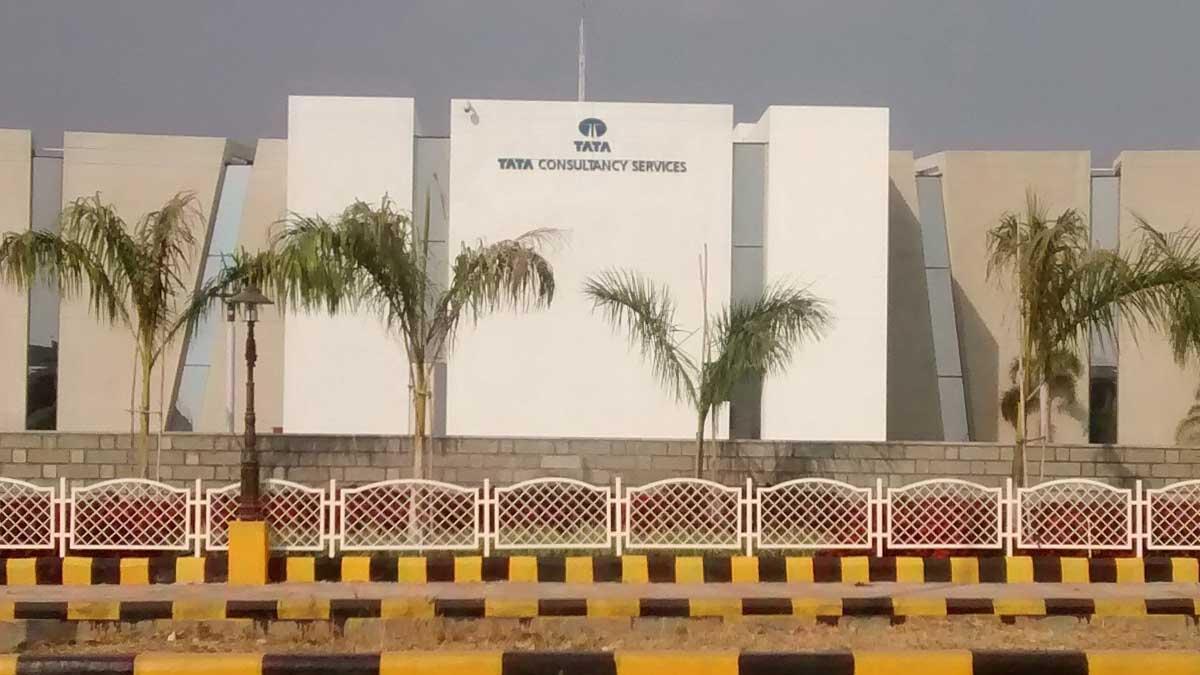
IMAGE: TCS' Nagpur campus. Kind courtesy Akki17690/wikipedia.org/Creative Commons
Tata Consultancy Services' decision to lay off roughly 12,000 employees, primarily mid- to senior-level managers, is being viewed by analysts as a move to shore up profitability rather than a shift towards an AI-driven future.
While the company cited evolving business needs and future readiness as reasons, industry experts say the action is a cost-cutting measure aimed at improving operating margins that have remained below the firm's aspirational range despite multiple efforts.
The announcement on July 27 came as a surprise to many in the Indian information and technology sector, where involuntary layoffs have typically been handled quietly.
Indian IT companies, as some of the country's largest organised sector employers, have historically avoided large-scale public cuts.
The sector employs around 6 million people, according to data from Nasscom.
TCS' operating margin has hovered between 24 per cent and 25 per cent for five consecutive quarters, below its stated aspiration of 26 per cent to 28 per cent.
For the quarter ended June 30, operating margin stood at 24.5 per cent, down 20 basis points from a year earlier.
The figure excludes wage hikes that TCS indefinitely deferred in April.
"I thought the demand was just coming back," said a senior analyst at a global brokerage firm, speaking on condition of anonymity.
"This is a pure cost take-out strategy to lift margins, and once done, they may provide wage hikes to the remaining."
During a post-earnings call after Q1FY26 results, Chief Financial Officer Sameer Seksaria told analysts the company had been witnessing a discrepancy between demand and capacity.
'In this quarter as well, we have invested in capacity... That is what is reflecting in our margins,' he said.
That 'excess capacity' largely refers to bloated mid-senior and senior layers of employees with experience between 9 years and 13 years, and 13 years and 17 years.
According to staffing firm Xpheno, the top seven Indian IT firms employ about 492,000 professionals in those bands, compared with 486,000 at the junior end (from fresh graduates to five years of experience) -- a group that draws significantly lower pay.
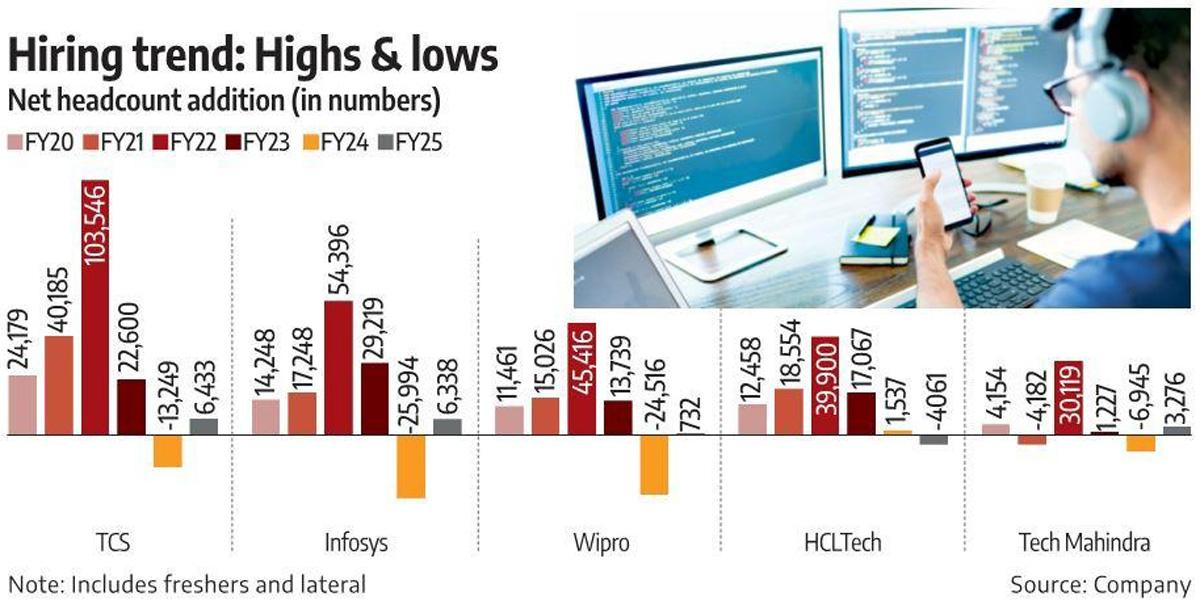
A lot of those people were hired during the peak of the pandemic in FY21 and FY22, according to analysts.
TCS hired 103,546 in FY22; the top five players cumulatively took in 273,377, the most in at least six years. Hiring has been going down ever since.
Persistently weak and uncertain macroeconomic conditions may have prompted TCS to act this time.
Revenue growth in constant currency terms had steadily declined -- from 15.4 per cent in FY22 to just 4.2 per cent in FY25.
"Demand has been down and margins have missed expectations," said Gaurav Vasu, founder of consultancy UnearthInsights.
"Also, many employees lack the client-relevant skills today. Roles like project managers, infrastructure support, and other support functions are now particularly vulnerable.
"There could be more slow, silent layoffs across the industry."
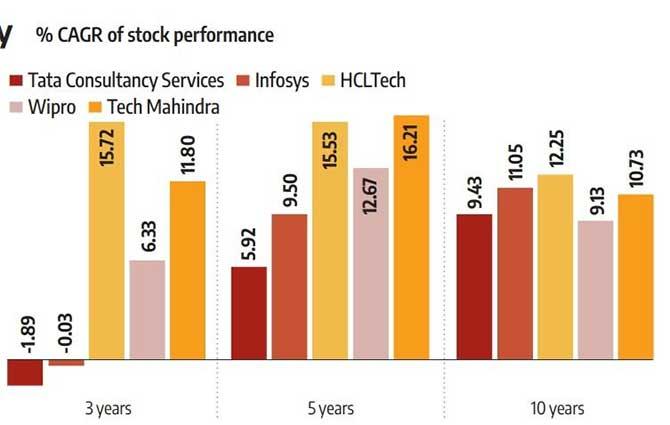
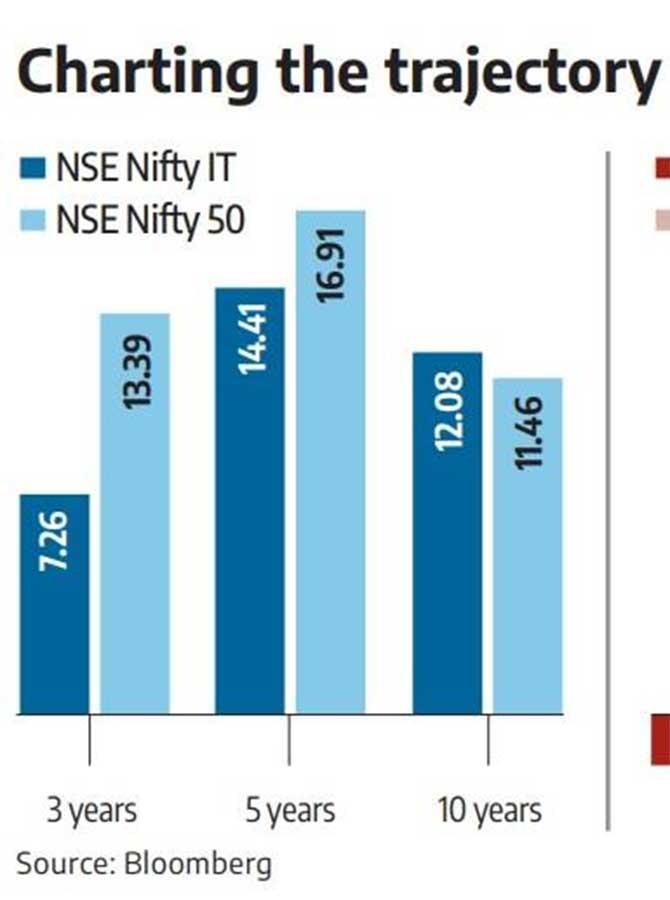
TCS' challenges on both margins and top-line growth have weighed on its stock.
Its share price has dropped nearly 30 per cent over the past year.
In comparison, Infosys is down 19.3 per cent, HCL Technologies 10.3 per cent, Wipro 4.7 per cent, and Tech Mahindra about 6 per cent. Industry veterans, though, supported TCS' action.
Ganesh Natarajan, executive chairman, GTT Solutions said TCS is doing the right thing by taking proactive action.
"Because there is no doubt that companies who will succeed in IT and non-IT with AI will have to move beyond GenAI and ChatGPT to a much more fundamental game changing use of AI.
"This fundamentally means more use of agenticAI, autonomous agentic AI..in this context the traditional style of pyramid will disappear. This restructure and rethink is important," he added.
Last month, TCS posted one of its weakest first-quarter results since 2020, with constant currency revenue shrinking 3.1 per cent and dollar revenue down 1.1 per cent.
It was the worst constant currency performance among the top five Indian IT service providers in the quarter.
TCS Layoff Jolt
Shivani Shinde, Avik Das
An air of disbelief hung over TCS offices on Monday, July 28, 2025, morning, a day after the largest IT services company sent out an unexpected communication to its employees, announcing its biggest layoff.
At TCS -- long seen as an ideal destination for steady and secure job -- employees found it tough to come to terms with the layoff announcement that broke the Sunday afternoon peace.
There were many, however, who had no clue on Sunday.
Since the official communication that 2 per cent of the workforce, or over 12,000 employees, would have to leave was sent out on a holiday, many employees learnt about the layoffs through the Monday morning newspapers, just before heading to office.
"I think the internal portal carried the update on Sunday afternoon, but most of us wouldn't have checked it. Reading about our own company's layoffs in the newspaper was shocking," said a mid-level employee who did not wish to be named.
"There was no prior indication from HR (human resource department). No announcement. Nothing."
This is the first time that TCS has officially announced a large-scale layoff.
The only comparable instance was in 2012, when the company had let go of around 2,500 employees.
For a Tata Group company -- and especially TCS, which weathered past crises like COVID-19 and the 2008 financial meltdown without cutting jobs -- this marks a dramatic cultural shift.
"TCS was considered a safe company. It stood by employees during every downturn. That's what makes this harder to digest," said another employee.
Several expressed discomfort over what they saw as a departure from the "Tata values".
Another noted: "This is happening just a year after Ratan Tata's passing."
The layoffs have also created confusion and mixed messaging internally.
Many employees pointed out that while the company had been consistently pushing for AI-readiness -- and encouraging staff to reskill accordingly -- this move seemed to contradict that effort.
"We're being told to train ourselves in AI and we've been doing it. Then why this layoff? What does it say about how AI-ready we really are," asked a disappointed senior executive.
The fear and anxiety now extend beyond TCS.
There is a growing concern that other major tech firms might follow suit.
Many are also apprehensive that the actual number of layoffs at TCS might be much higher than what has been announced.
"Attrition is already high. If TCS had simply managed workforce exits through natural attrition, it could have avoided this disruption over the next two to three quarters," said a senior HR leader in the industry.
Meanwhile, employee unions have taken up the cause of TCS employees.
The Karnataka State IT/ITeS Employees Union (Kitu), in a letter, condemned this layoff as illegal action by the TCS management.
The union said it was approaching the labour department against the 'unlawful move'.
'According to the Industrial Disputes Act, it is a punishable offence for an employer to compel an employee to resign.
'Every employee has the legal right to refuse to sign a forced resignation,' according to a Kitu letter.
Overhiring hangover
Industry analysts and HR experts largely attribute the decision to the overhiring spree during the pandemic years.
While many peers corrected course by freezing or slowing down hiring between FY23 and FY25, TCS continued to hire aggressively from campuses and laterally, especially to build AI-related capabilities.
What has surprised many observers is that the layoffs are focused on the mid to senior levels -- typically the most stable layer in IT organisational structures.
Experts believe this could prompt a wider reassessment of talent pyramids across the sector.
Only those who have either domain expertise, knowhow of client IP, or are good at technology, will be able to survive.
According to data from specialist staffing firm Xpheno, the highest churn across Indian IT players occurs in the 1 to 5 year experience bracket (17 per cent), followed by the 5 to 10 year band (12 per cent).
In contrast, attrition drops to 7 per cent for those with 10 to 15 years of experience and just 4 per cent for employees with over 15 years.
Kamal Karanth, cofounder of Xpheno, attributes the current bloated structure to the hiring boom of 2021-2022.
"The big-fat middle layer is a net outcome of the hyper-hiring phase, combined with three cycles of low to no fresher intakes," he said.
"A large chunk of lateral hiring made during the demand surge now sits in the 5 to 13 year experience range -- the very layers seeing restructuring now.
"Ironically, these were also the layers with the highest churn during the hiring boom," he added.
Neeti Sharma, CEO of TeamLease Digital, said that people managers, especially those with 15 to 20 years of experience, are the most impacted.
"These are typically project managers handling backend delivery. Many have not upskilled enough to take on front-facing or AI-related roles. If they don't adapt to the new demands, it is tough to justify those roles."
Feature Presentation: Ashish Narsale/Rediff

