
'We have seen that stablecoins lack the basic attributes of money, their advantages are neither unique nor unambiguous and their risks are all too real.'
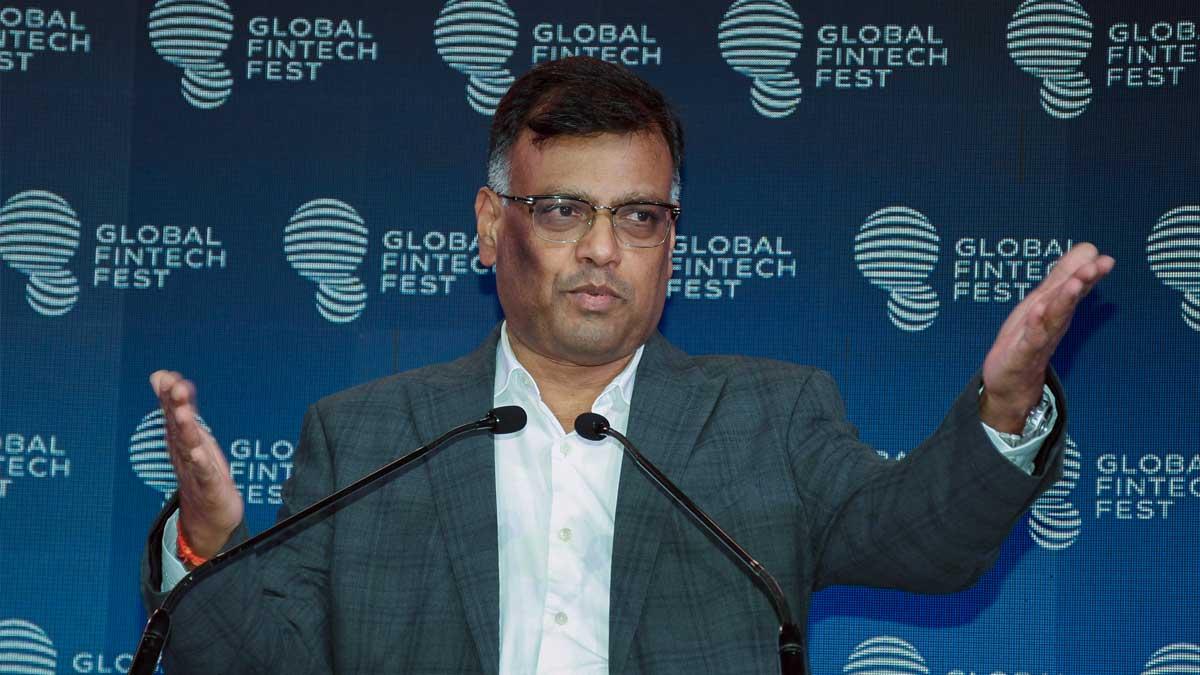
India's approach towards stablecoins must be guided by caution as it can undermine trust in the currency and finance system, Reserve Bank of India Deputy Governor T Rabi Sankar said on Friday.
Speaking at the Mint annual BFSI Conclave 2025, Sankar pointed out that stablecoins do not serve any purpose that cannot be served by fiat money.
India already benefits from a payments landscape that is highly efficient, reliable, and robust, the RBI deputy governor pointed out.
With UPI, RTGS, and NEFT offering fast, low-cost, and secure payment capabilities to millions of users, there is little justification for integrating stablecoins into the financial system -- even before considering the broader risks they pose, Sankar said.
"We have seen that stablecoins lack the basic attributes of money, their advantages are neither unique nor unambiguous and their risks are all too real," the deputy governor said.
According to Sankar, India's policy on stablecoins must be driven by domestic priorities.
"Despite India having good macroeconomic conditions and sound policies, the domestic factors and compulsions must be considered when evaluating policy options for stablecoins.
"The choices made today will impact the future of our monetary system and financial sector integrity," Sankar cautioned.
He outlined that India's strategy should be anchored around four principles: Preserving trust in the national currency, monetary and payment systems; safeguarding monetary sovereignty and macro-financial stability; encouraging responsible innovation through CBDCs and interoperable payment systems; and ensuring that innovation strengthens -- rather than bypasses -- the regulated financial system.
Having said that, he emphasised that India must acknowledge the promise of innovation that technologies such as blockchain and tokenisation bring, and that a central pillar of this strategy is the adoption and cross-border readiness of Central Bank Digital Currencies (CBDCs).
CBDCs are digital tokens like stablecoins yet they are inherently superior since they satisfy all the attributes that money should have -- fiat, single, trusted and representing value -- and do not pose many of the risks associated with stablecoins.
CBDCs can perform all the functions stablecoins claim to offer such as programmability, atomic settlement, lower cross-border frictions, while being fully anchored within the existing financial system, Sankar said, adding that encouraging CBDC use domestically is essential and can be done by making CBDC functionally similar to physical cash, especially with respect to tiered anonymity.
Sankar highlighted that the cross-border aspect of CBDC is even more critical.
Much of the appeal of stablecoins lies in their promise of cheaper, faster international transfers.
But the same efficiency can be achieved through bilateral or multilateral CBDC corridors, he said, adding that this is an area where India can play a shaping role, by helping build the case for interoperable CBDC arrangements among emerging markets and beyond.
According to Sankar, India should look at interlinking of fast payment systems (FPS).
"Interlinking domestic FPS directly contributes to the G20 objectives of faster, cheaper, more accessible and transparent cross-border payments.
"The recent linkages between UPI and several partner jurisdictions are important steps forward, increasingly reducing the need for any private digital alternatives for remittances," he said.
Feature Presentation: Ashish Narsale/Rediff
