
'You set up your SIPs and you do not touch them. Not during COVID, not during a war scare, not when your neighbour tells you the market is finished. You let the noise pass over you.'
'The beauty of this approach is that it does not require courage or conviction in the moment. It just requires inertia -- keep the SIP running and do not look at your portfolio too often.'
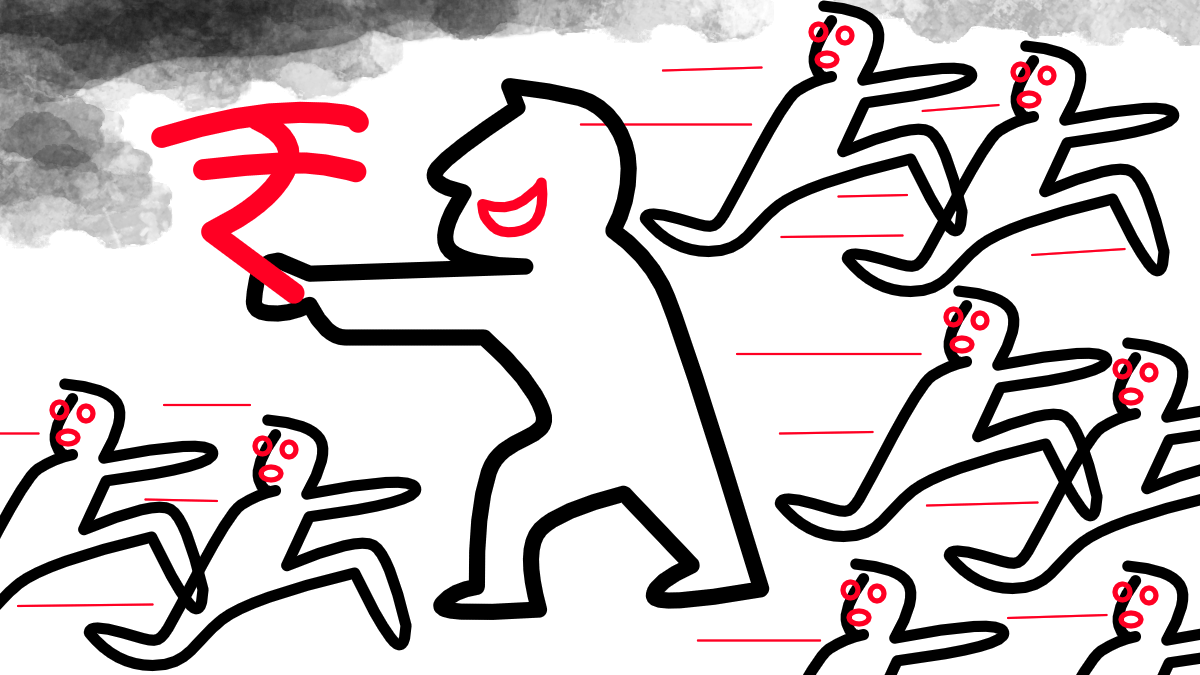
"Doubling your SIP when everyone is panicking but the market is still expensive is a different proposition entirely. Right now both conditions are met simultaneously -- fear is at an extreme and valuations are reasonable. That combination does not come around very often," Nikhil Gangil, Intrinsic Value Equity Advisors, tells Prasanna D Zore/Rediff in the concluding segment of the interview.
What measures can the RBI and the government take to stabilise the rupee?
People tend to focus almost entirely on what India imports -- roughly $160 billion of crude oil and about $70 billion of gold. Those are large, visible numbers, and they dominate the conversation about rupee pressure. But the other side of the ledger gets far less attention.
We export around $80 billion worth of petrochemicals, $60 billion in engineering goods, and meaningful volumes of rice and agricultural commodities. That is a substantial export base, and in extreme situations the government does use that leverage -- if we are haemorrhaging dollars on the import side, they will find ways to accelerate dollar earnings on the export side.
Beyond that, there are several levers that are either already being used or are available. The RBI has been selling dollars directly from its reserves to slow the pace of rupee depreciation -- that is the most immediate tool. But that burns through reserves, so it cannot be the only answer.
On the structural side, the more durable fix is attracting dollar inflows. That is where the market tax argument I mentioned becomes relevant -- remove LTCG, STCG, and STT, and FIIs have a clear reason to bring money back into Indian equities.
We are, right now, the only fairly valued market in the world. You do not need to manufacture an argument for FII inflows -- the valuation case makes itself, provided the tax friction is removed.
Import compression is the other side. Higher import duties on gold, tighter curbs on non-essential imports -- these reduce the dollar outgo. The government has already moved partly on this. There is also the question of NRI bond schemes, which have been used in past stress episodes to bring in foreign currency directly.
The honest truth is that no single measure stabilises the rupee. It is always a combination -- slow the outflows, accelerate the inflows, defend with reserves where necessary, and wait for the geopolitical situation to ease.
The RBI and the government know the playbook. What matters is whether they execute it with enough urgency.
Why are FIIs continuing to sell Indian equities even as domestic SIP investors keep pouring money in?
It comes down to how FIIs are wired. They are momentum investors -- they do not hunt for bottoms, they chase trends.
Over 20 years of data, FIIs have never been consistent buyers at a market bottom. The pattern is remarkably consistent: They keep selling for two to three months after the bottom is already in, and only return once the market has crossed and held above its 200-day moving average.
Not valuation, not fundamentals -- momentum is the only signal they act on.
Right now, they also have specific global reasons to stay cautious. The West Asia conflict has triggered a classic risk-off response -- money moves to the dollar and US treasuries, out of equities in emerging markets.
India is not being singled out; it is part of a broader EM selloff. A rupee down over five per cent this year adds a second layer -- even if Indian indices hold in rupee terms, dollar-denominated investors are losing money on the currency alone.
But here is what is different this time. The domestic SIP investor is absorbing FII selling in a way that simply did not exist in previous cycles. That is a structural buyer with staying power.
So it is now our job -- as domestic investors, fund managers, and advisors -- to bring the market to the point where momentum is clearly established. Once that happens, FII inflows will follow. They always have.
Currency stabilisation will help, but momentum is the real trigger. The FIIs will not lead this rally. They will join it once it is already underway.
What is your advice to retail investors -- both direct equity and mutual fund SIP investors?
There are really only two ways a retail investor makes money in the market -- most people manage to avoid both of them.
The first is to go completely contrarian. You ignore the crowd, tune out the news cycle, look at valuations, identify good businesses, and buy precisely when nobody else wants to. That sounds simple, but it is psychologically brutal.
When the headlines are screaming about war, currency collapse, and economic ruin, which is exactly where we are right now, the contrarian is the one quietly adding to positions. Most people simply cannot do it.
The second way is to become completely consistent.
You set up your SIPs and you do not touch them. Not during COVID, not during a war scare, not when your neighbour tells you the market is finished. You let the noise pass over you.
The beauty of this approach is that it does not require courage or conviction in the moment. It just requires inertia -- keep the SIP running and do not look at your portfolio too often.
Both approaches work. What does not work is the middle path -- the investor who is roughly consistent until they get scared, roughly contrarian until they get greedy, and ends up doing the opposite of what they should at every turn. That, unfortunately, describes most retail participants.
Markets are designed to transfer money from the impatient to the patient, from the emotional to the disciplined.
Right now, with the SIP stoppage ratio at 95 per cent in March and fear at peak levels, both types of investor have a clear signal.
The contrarian sees the valuation and the pessimism and acts. The consistent investor simply does not stop. Either way, the direction is the same -- stay in, or add more.
Any specific advice for SIP investors right now?
Watch the SIP stoppage ratio. Most people have never heard of it, but institutional investors track it closely as a contrarian indicator.
Here is how it works. Every month, AMFI -- the Association of Mutual Funds in India -- publishes data on how many new SIPs were started and how many existing SIPs were discontinued or paused.
The stoppage ratio is simply the number of SIPs stopped divided by the number of new SIPs started that same month. So if 80 lakh existing SIPs were discontinued and 100 lakh new ones were registered, the ratio is 80 per cent.
Crucially, this is not measured against the total base of existing SIP investors -- it is always the stoppage number against the new registrations in that specific month. That is what makes it a live, real-time sentiment gauge rather than a lagging stock figure.
When that ratio crosses 75 per cent, it tells you that fear is overwhelming -- more people are running away from the market than are coming in fresh.
Historically, that is a classic contrarian buy signal. When it drops below 40 to 45 per cent, the mood has flipped to greed and complacency -- that is when you should be turning cautious.
And where does that ratio stand right now?
It touched 95 per cent in March 2026. That was one of the most powerful signals I have seen in recent years, and it was one of the key reasons I said on March 29 that the market had made its bottom.
To put that in context -- in April 2020, at the absolute depths of the COVID crash, the ratio hit 101 per cent. That means more SIPs were being stopped than new ones were being started.
Mathematically it sounds impossible, but it simply reflects that in a moment of peak panic, cancellations outrun fresh enthusiasm entirely.
Go back further -- 2013, 2016, 2019, every significant market bottom -- the SIP stoppage ratio was above 80 per cent each time without exception. It has never failed as a directional indicator at extremes. The crowd, in aggregate, is a near-perfect contrary indicator.
So is this the time to actually double one's SIP?
Yes -- but with one important condition: The market must be at fair valuation. Doubling your SIP when everyone is panicking but the market is still expensive is a different proposition entirely.
Right now both conditions are met simultaneously -- fear is at an extreme and valuations are reasonable. That combination does not come around very often.
The logic is straightforward. When 95 out of every 100 people starting new SIPs are matched by people stopping theirs, you are looking at collective capitulation. That is not a reason to stop -- it is a reason to accelerate.
The market does not bottom when things get better. It bottoms when people stop believing things will ever get better. That is exactly where we were in March.
I track seven such indicators in total, and I published all of them in a newsletter on March 29. At that point, nearly all seven were aligned. You will rarely get perfect alignment across all of them -- but when three or more point in the same direction simultaneously, that is as reliable a signal as you will find in markets.
Right now, that composite picture is clear. Stay in, and if you can, add more.
Disclaimer: This article is meant for information purposes only. This article and information do not constitute a distribution, an endorsement, an investment advice, an offer to buy or sell or the solicitation of an offer to buy or sell any securities/schemes or any other financial products/investment products mentioned in this article to influence the opinion or behaviour of the investors/recipients.
Any use of the information/any investment and investment related decisions of the investors/recipients are at their sole discretion and risk. Any advice herein is made on a general basis and does not take into account the specific investment objectives of the specific person or group of persons. Opinions expressed herein are subject to change without notice.