
India's fertiliser subsidy bill is projected to increase by approximately 70,000 crore, reaching around 2.41 trillion in FY27, primarily due to rising import costs exacerbated by the ongoing West Asia crisis.
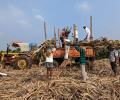
The Indian government's decision to ban sugar exports until September 30 has drawn sharp criticism from the sugar industry and farmer leaders, who fear long-term negative impacts despite the stated aim of controlling domestic prices and ensuring availability.

'This system will be of immense help in agricultural planning, disaster management and water resources management.'

A crucial Tata Trusts board meeting was unexpectedly postponed, highlighting internal conflicts over veto power, Tata Sons listing, and trustee eligibility, raising concerns about the stability of the $180 billion conglomerate.

The top agenda of the meeting includes a review of Tata Trusts representation on the Tata Sons board.

Tata Trusts, which holds a significant stake in Tata Sons, is facing a mandate to immediately comply with Section 30A(2) of the Maharashtra Public Trusts Act, 1950, requiring two of the three life trustees at Sir Ratan Tata Trust to step down to meet the 25 per cent cap on perpetual trustees.
Tata Trusts, which holds a significant stake in Tata Sons, is facing a mandate to immediately comply with Section 30A(2) of the Maharashtra Public Trusts Act, 1950, requiring two of the three life trustees at Sir Ratan Tata Trust to step down to meet the 25 per cent cap on perpetual trustees.

'Monsoon is the pran (life) of our water system.' 'A weak monsoon will have a very negative impact on crops and people's lives.'

If Tata Sons is listed, the special veto rights of Tata Trusts, under Article 121A, may have to go away.

The finance ministry has clarified that its letter to state chief secretaries, urging them to align their bonus policy to promote pulses, oilseeds, and millets, was an advisory and not a directive. This clarification comes in response to Tamil Nadu Chief Minister M K Stalin's criticism, who called the advisory a 'treacherous act against farmers'.

Despite significant price differences, Indian farmers are increasingly adopting non-subsidised speciality fertilisers, which are seen as a potential solution to the rising fertiliser subsidy burden exacerbated by global supply shocks.

'The West Asia or the Gulf crisis has shown that what we develop as national infrastructure when things are not as bad as they could be, we forget to plan for adversities.'

While the leadership issues may get sorted in the upcoming board meetings of Tata Trusts and Tata Sons, listing of the holding company of the Group on stock exchange should potentially resolve the bigger question on ownership and control

India's sugar consumption is projected to fall by nearly 400,000 tonnes in the 2025-26 season, primarily due to the ongoing liquefied petroleum gas (LPG) shortage exacerbated by the West Asia conflict and unseasonably cool weather.

A poor monsoon could drag overall economic growth and compound the impact of the West Asia conflict on the Indian economy.

'Whether you will bring this down and cause hurt to senior citizens, who are probably living on that little interest rate that they earn out of it... But equally, if I just look at the kitty of the National Small Savings Fund, it is from that same kitty that I'm borrowing.'

The Confederation of Indian Industry (CII) has proposed a 20-point policy agenda to the finance ministry, including a conflict-linked emergency credit line guarantee scheme and tax rationalisation on energy inputs, to support MSMEs, exporters, and energy-intensive industries affected by the ongoing West Asia war.

"The world might face a food crisis if the war continued till the end of April, as it could have a dramatic impact on planting in Europe and North America," said Matt Simpson, CEO of Brazil Potash.

'During the hot season (April to June), above-normal minimum temperatures are likely over most parts of the country, except in some regions of Maharashtra and Telangana, where minimum temperatures are expected to be normal to below normal,' IMD said.

Unseasonal rainfall could damage standing wheat crops, especially late-sown fields nearing maturity and grain-filling stages.
 © 2026 Rediff.com - Advertise with us - Disclaimer - Privacy Policy - Sitemap - Feedback - About us - Terms of use - Grievances