
Photographs: Reuters
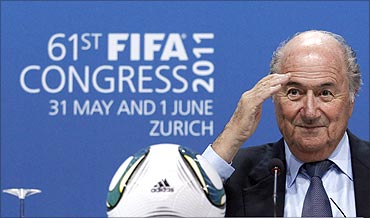
Delegates gave Blatter overwhelming backing to reform soccer's governing body from within, rejecting a call from England to delay the election and then giving the Swiss 186 of the 203 votes cast.
"We will put the ship back on course in clear transparent waters," the 75-year-old Blatter told delegates.
Yet even as he received flowers and soaked up the applause Blatter was facing trouble, after Germany called for a review of the process in which Qatar awarded the 2022 World Cup.
Blatter, who joined FIFA in 1978 and has been its president since 1998, did not address that issue directly but said he was determined to clean up the sport's governance after a series of allegations that left him feeling personally "slapped".
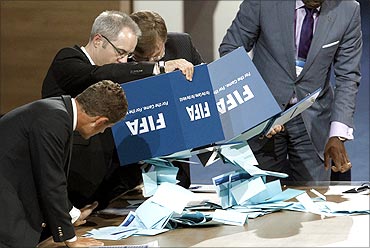
With Qatari Mohamed bin Hammam having dropped out of the race -- he was subsequently suspended pending an inquiry into bribery claims -- Blatter effectively sealed victory when a motion to postpone the vote was defeated by 172 to 17.
The actual election was a formality
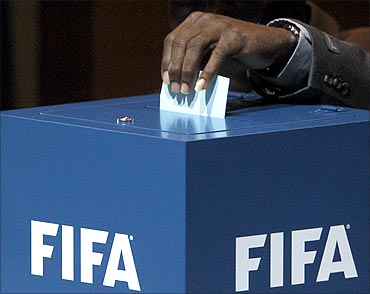
The actual election was a formality.
Blatter, who has repeatedly said this will be his final term, traced FIFA's problems back to last year's World Cup vote, when the inner circle of executive committee members chose Russia to host the 2018 tournament followed by Qatar in 2022.
Immediately following his election win, Blatter proposed and won the backing of Congress to shift power to award future World Cups to FIFA's full 208-member congress, though the 2026 event will not be up for grabs for another six or seven years.
Congress also accepted a proposal to strengthen the ethics committee by separating investigation and decision-making powers and another to create a new watchdog called the "solution committee".
"There was so much doubt leading up to this, there was a lot of talk, but all of that is in the past," Blatter told Reuters.
"Now we have created instruments to fight against all that is bad in FIFA with more transparency."
A large measure of the doubt has been over the decision to award the 2022 World Cup to Qatar, though the bid team has denied any wrongdoing in the campaign.
Theo Zwanziger, head of the influential German Football Association, said FIFA could not afford to ignore the suspicions, which have been denied by Qatar's bid team.
"There is a considerable degree of suspicion that one cannot simply sweep aside," Zwanziger told German television.
FIFA's internal chaos has magnified the drama
FIFA is facing what general secretary Jerome Valcke agreed was a "watershed moment", with the crisis being compared to the Salt Lake City corruption case the International Olympic Committee had to deal with in 1998.
Since then the IOC has strictly controlled the bidding process, banning all members from travelling to candidate cities unless they are part of the official evaluation commission.
Blatter will need to provide more detail on his own plans if he is to satisfy critics he is equally serious about reform.
The Swiss has led FIFA through a period of unprecedented prosperity on the sale of TV rights and sponsorship.
The financial report submitted to delegates on Wednesday showed reserves of $1.3 billion, with TV rights for the 2010 World Cup in South Africa having brought in $4.2 billion between 2007-10.
Behind the money and the glitz, however, the game's reputation has been put under the microscope after an outbreak of corruption allegations and the suspension of Bin Hammam and fellow executive committee member Jack Warner.
The two men, who are facing an investigation into bribery claims in the election, have denied any wrongdoing.
In another twist, Chuck Blazer -- an American whose whistle-blowing led to the suspension of Bin Hammam and Warner -- was sacked on Tuesday from his position on CONCACAF.
An hour later, that organisation, which runs soccer in North and Central America and the Caribbean, declared the dismissal invalid but the split deepened on Wednesday as acting president Lisle Austin insisted Blazer had indeed been lawfully dismissed.
The internal chaos magnified the drama surrounding the FIFA Congress in Zurich.
Before the election, Swiss President Micheline Calmy-Rey called for swift FIFA reform, telling delegates the ruling body needed to "take seriously" the criticisms voiced about corruption.
"What is important is to restore full confidence in the organisation; let not money spoil your ideals," she said.
'Sepp Blatter will be judged by his actions from now'
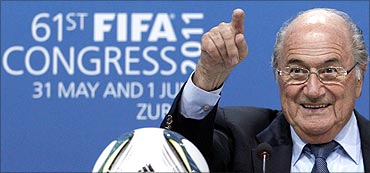
FIFA has also faced criticism from four of its six top-tier sponsors concerned about possible damage by association.
Reacting to the election result, British sports minister Hugh Robertson welcomed Blatter's new proposals while expressing his regret that the vote had not been postponed.
"I think Sepp Blatter will be judged by his actions from now," Robertson told BBC television.
"There are some good things -- the fact that future World Cups will be decided by the congress...and the committee that is going to look into reform of governance. Those are two immensely positive moves.
"Of course, he will be judged by the results, not what he says today."

Comment
article