

Photographs: Getty Images
Leading sports lawyer Simon Pentol believes Manchester City will eventually reach a compromise with suspended striker Carlos Tevez to avoid possible litigation.
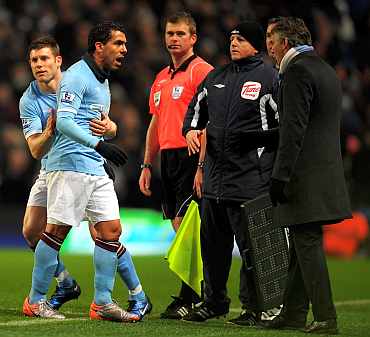
City have banned the player for up to two weeks pending an investigation into his conduct after manager Roberto Mancini said the Argentine refused to go on as a substitute during the 2-0 Champions League defeat at Bayern Munich on Tuesday.
"My gut feeling is they will find a short-term compromise with a long-term view of moving him on which would save City and Tevez the embarrassment of having to litigate and keep everyone financially happy," Pentol said in an interview on Friday.
"It wouldn't surprise me to see City keep him until the end of the season and while he's there they will engage with his representatives to move him on to a club that will pay them a big fat transfer fee come next August, or even in January.
"They will then have the money for him, he can go and join someone else and everyone keeps their honour because that's the most sensible, pragmatic way to approach this," he added.
Similarity between Mutu and Tevez's case

Photographs: Getty Images
Pentol likened the situation to the legal dispute between City's Premier League rivals Chelsea and Adrian Mutu after the Romania striker tested positive for cocaine in 2004.
Chelsea decided Mutu's failure to pass a drugs test represented a breach of contract. They sacked the player and took him to court.
The London club were eventually awarded 㾺.1 million to cover the cost of buying Mutu, plus the lost opportunity of recouping a transfer fee from moving him to another club minus the money they would no longer have to pay for his wages.
Pentol, who has represented clubs and players for several years in disputes and regulatory affairs, said the Tevez row was more complex than the Mutu situation.
"In Mutu's case there was firstly a very clear breach of the morality clause, i.e., a player being found with drugs in his system," he explained.
"Secondly there would have been almost certainly a specific clause in his contract that you do not take drugs, performance-enhancing, social or otherwise, and Mutu also didn't try to pretend there hadn't been a breach of contract to justify termination of his deal.
"The key difference is Tevez would want to argue he didn't breach his contract and he would argue City breached the contract by using the events of last Tuesday to get him out of the club."
'The player more powerful than Mancini'
Photographs: Getty Images
Ultimately, Pentol said, it could be that Tevez emerges from the situation in a stronger position than his manager.
"As I understand it Tevez has a very good relationship with Sheikh Mansour and the club owner's representatives and it may, in truth, make the player more powerful than Mancini," said Pentol.
The 51-year-old barrister also recalled Tevez's controversial spell with West Ham United when the London club were fighting to avoid relegation in 2007.
"Tevez ultimately cost Alan Pardew his job as manager of West Ham when he refused to play him to a greater extent, and Javier Mascherano to a lesser extent, because they were brought in by the then-board above his head," said Pentol.
"The manager felt he had been lumbered by them and the deal had been done for the benefit of the incumbent board and he chose not to play either of the players.
"Pardew eventually got the bullet, Alan Curbishley came in, Tevez played virtually every game for the rest of the season and the rest is history," added Pentol.
'No shortage of strikers'

Photographs: Getty Images
"In February West Ham were dead ducks but finally of course Tevez scored the winning goal in the last game at Manchester United and the club stayed up. That's the sort of thing that can happen in football."
Pentol added there would be no shortage of takers if City decided to allow Tevez to leave.
"Some clubs might say, 'Carlos Tevez? We wouldn't touch him with a barge pole," he said.
"But other clubs might say, 'We'll do a deal with City, split his vast salary, bring him here for three months, thanks very much'.
"That is the sort of thing that can happen in football because even with the bad boys, the worst boys, there is always some club or some manager who think they can turn them around and make the best of them," he added.

Comment
article