
'All the good in our family began with His arrival. For 20 years we have brought Him home with love and reverence.'
As Mumbai readies to celebrate its biggest festival, a look at Ganeshotsav through the eyes of a devotee.

This Ganesh Chaturthi will mark 20 years since Jalandar Radhakrishna Patange started bringing Bappa home.
"He has changed our lives. All the good in our family began with His arrival," says Patange whose family starts prepping three months prior for the most important festival of the year.
The house is cleaned thoroughly; every alternate year it gets a new coat of paint. Plans are made about how to decorate the mandap and trips are made to Crawford Market at the other end of town to buy the novel decoration items, torans and everything needed for the pooja.

The television is moved out of its place in the one-room-kitchen flat to make way for Bappa. The space is then elaborately set up as a grand pedestal with lights, flowers, fruits, grain, sweets, decorative pieces collected over the years, including a desktop Indian flag.
The order for the idol is placed weeks in advance. For the past ten years, Patange has bought it from the same vendor. This year he offered Rs 4,251 for the murti and will bring it home with reverence on Tuesday night.

In earlier years, he would bring it by local train from Lalbaug, home to the city's grandest Sarvajanik Ganeshotsav Mandal -- Lalbaughcha Raja, the King of Lalbaug.
Then a group from his neighbourhood would pool in to hire a tempo and travel to the Ganpati artisan's stall to bring Bappa home.
It was a nice way of community bonding where they would drop into each other's homes for darshan.

Now he gets the idol from a place closer to home by car or taxi.
"Our first Bappa idol was placed on our kitchen slab in our rented accommodation. We had put the stove on the floor. Two people had come for darshan the first time," says Patange remembering those days with warmth.

One of those friends does not keep good health now. But the other has continued to visit each year.
Another friend used to visit as a bachelor, now he comes with wife and family. He has come each year, without fail, travelling a great distance in the megapolis which is famous for long-lasting friendships.

Since moving to his own flat 11 years ago, Patange invites residents of his building, friends and colleagues he has known over the years.
Every year on the penultimate day of visarjan, he invites 50-60 people for lunch. Tables are laid in the corridor where people sit to have a vegetarian meal of jeera rice, dal, vegetable and modaks.
His wife Manisha's friends from the building come to help in making modaks. Friends who work as cooks lend a hand in preparing the big meal.
It is time of bonding, friendships, sharing and coming together -- all under Bappa's gaze and grace.
Since many who come for darshan offer bananas at Bappa's feet, the couple makes time every evening to feed them to a cow in the neighbourhood.

"We make all the food at home. It is all part of a happy, festive experience. We feel Bappa's blessings through each day. It is among the happiest times of the year for us," says Patange who began life driving a vegetable truck and has gone on to build a solid life on hard work and the ability to learn new skills quickly.
The first time, when he and his wife decided to bring Bappa home soon after moving to Mumbai from their village in Maharashtra, they could not go through with the plan due to some hindrance.

When a few months later, Patange took seriously ill for three months, he thought it was a consequence of not bringing Bappa home.
Next year, he made it a point to observe the festival for a full 10 days and has not wavered since.
"My life just turned for the better after that. My children studied well, I bought a house, got my daughter married, my son found a good job and I became a grandfather."
"Bappa made all this possible. He has blessed us richly," he says folding his hands in reverence as he prepares to bring Him home again.
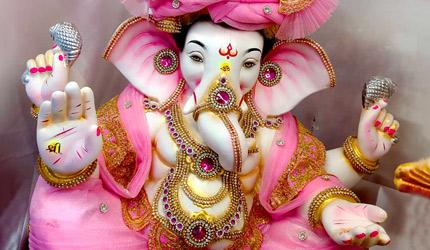
Photographs curated by Manisha Kotian/Rediff
Feature Presentation: Aslam Hunani/Rediff




 © 2025