
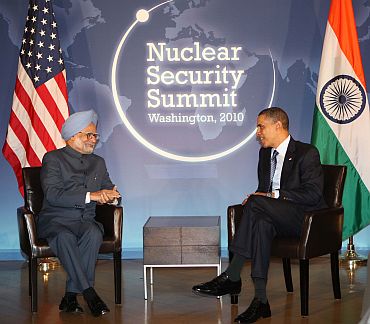
A Correspondent in New Delhi
Despite being a policy document, the Prime Minister's Office prepared it for background purposes.
These issues will also be discussed at Hyderabad House on Monday when the leaders meet with their respective teams.
Recognising that President Obama's visit was not aimed to achieve immediate goals, a policy brief circulated amongst top strategists and government officials by the PMO suggests building a base for long term India-US relations for 2020.
The policy summarises the conclusion of a study commissioned to various think-tanks ahead of the presidential visit.
The informal brainstorming group, which includes National Security Adviser Shiv Shankar Menon, former NSA during the National Democratic Alliance Brajesh Mishra and former ambassadors to the US Naresh Chandra and K S Bajpai will help sensitise US officials during the formal and informal interactions between the two sides.
The brief realises that while the strategic partnership of July 2005 laid out a roadmap for the two countries in various sectors, the assessment shows that the pace of this partnership has been 'uneven.'
Significantly, Pete Dagher, formerly chief of staff for Obama's presidential campaign, recently told an Indian audience that India needs to lobby hard in Washington, DC with an imaginative mix of vision and deft planning to achieve its strategic goals.
The US must treat India on par with other nations
Photographs: Adnan Abidi/Reuters
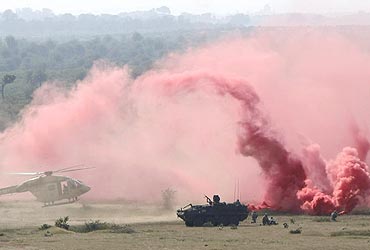
The policy brief suggests that Washington should make sure that defence commerce between the US and India should follow the rules of the World Trade Organisation, which means using the Most Favoured Nation tag.
The US should treat India in matters of defence transfers in no less a favourable manner than it treats its other customers, who are not bound by a military alliance.
In general, if a principle of reciprocity and freedom of choice is maintained, the chances of further defence cooperation will be substantially enhanced.
'Intel sharing should be established as a firm pillar of bilateral ties'

Photographs: Rediff.com
In this process, both the US and India, however, have to overcome problems with regard to their domestic constituencies as well as legal provisions and rulings, geo-strategic compulsions and politico-military issues.
The current cooperation between them, for various reasons, appears to be uncertain.
The next decade would be a test for both partners to reach the zenith of cooperation of which intelligence sharing should be established as a firm pillar.
'Cyberspace must remain free and secure'
Photographs: Rick Wilking/Reuters
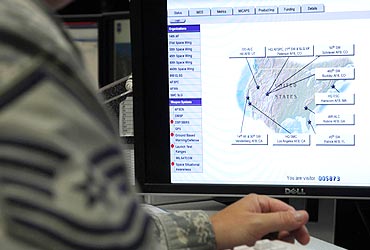
The partnership had a severe setback following alleged espionage involving secretariat officials responsible for the Forum and a lady US embassy official.
The paper calls for sharing best practices and coordinating approaches geared towards a common vision of ensuring that cyberspace remains open, free and secure.
Dual-use technology is the key
Photographs: Reuters
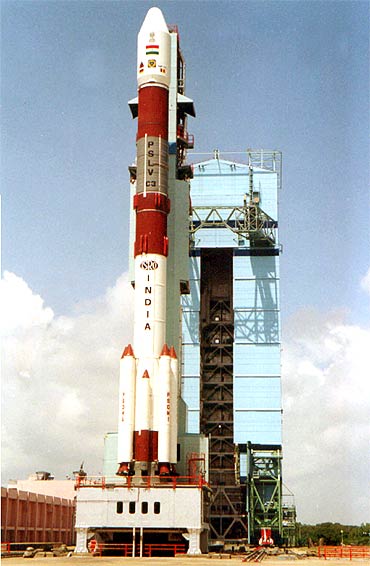
India and the US should now seriously explore how to mange future trade dual-use technology in a manner that helps global trade without affecting international security.
India, US must abandon their rigid positions
Photographs: Jim Young/Reuters
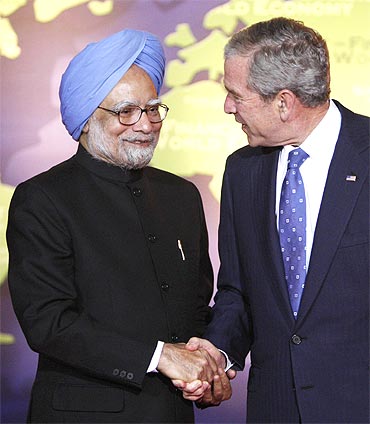
A resolution of the matter to the satisfaction of both sides would require both India and the US to abandon their current rigid positions.
If this is resolved then the way is open for further nuclear cooperation between the two countries in all matters pertaining to civilian nuclear use in the future and in particular cooperating on nuclear safety and security issues, assisting new entrants to civil nuclear power in managing their nuclear programs safely.
India with its strong base in nuclear research can join with the US in managing future global civil nuclear programmes in a manner which is equitable and non-discriminatory.
US must alter its Pak aid policy
Photographs: Jonathan Ernst/Reuters
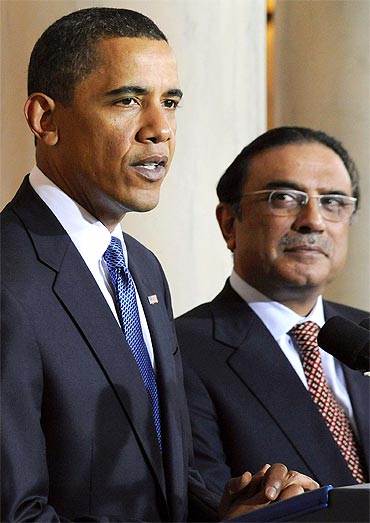
Pakistan has been promised huge amounts of aid without any method aimed at ensuring the appropriate use of the aid.
The US administration has shown some intentions of bringing about a change in its policy towards Pakistani aid.
Ironically, these intentions have been far from being translated into policy statements.
US must consult India on Afghanistan
Photographs: Kevin Lamarque/Reuters
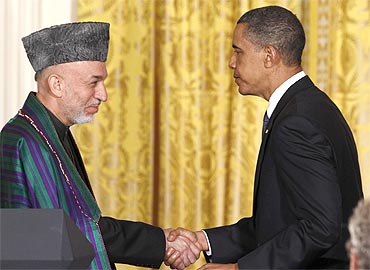
More significantly, the US must engage India more deeply in the deliberations on any future strategy for the solution of the Afghan issue.
India disapproves of the PSI
Photographs: Kim Kyung Hoon/Reuters
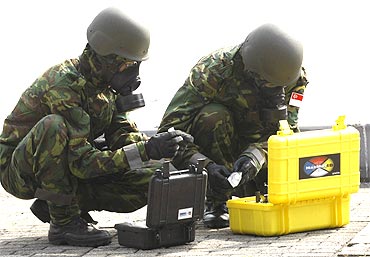
Similarly, India sees the PSI as a pre-emptive tool targeting US adversaries, which India disapproves of.
Even on nuclear terrorism, India could find partnerships ineffective unless the source of proliferation and terror (read Pakistan) is adequately addressed.
article