
'The Pahalgam terror attacks and the conflict that followed were a big blow to local tourism.'
'And just when things were starting to go back to normal, the floods, caused by heavy rain, spoiled all chances of a bounce-back this season.'
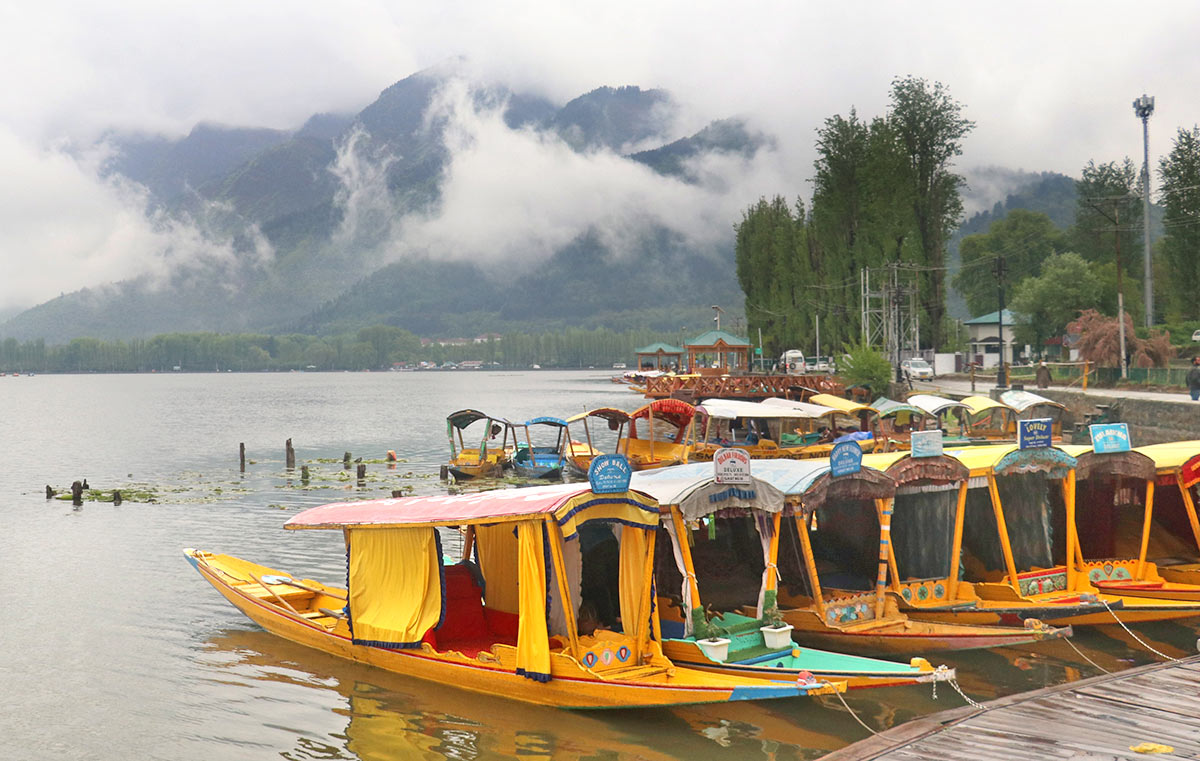
Air travel and tourism in Jammu and Kashmir and Ladakh are yet to recover after the Pahalgam terror attack in April, with the Airports Authority of India (AAI) data showing that passenger traffic at Srinagar, Jammu, and Leh airports remains well below last year's levels, marking a sharp reversal from the steady growth seen in the same period last year.
The Union Territories of Jammu and Kashmir and Ladakh have three major civilian airports -- Jammu, Srinagar and Leh.
According to the AAI data, reviewed by Business Standard, the monthly passenger numbers at Srinagar airport are yet to claw back to last year's levels.
In May this year, the airport handled 161,214 passengers, a steep 67.1 per cent year-on-year drop.
In August, it was 257,867, 17.9 per cent lower than in the same month last year.
For travel operators in the region, this has been a washout season.
"The Pahalgam terror attacks and the conflict that followed were a big blow to local tourism. And just when things were starting to go back to normal, the floods, caused by heavy rain, spoiled all chances of a bounce-back this season," said a hotel operator who has been battling dwindling occupancy rates since April.
During April-August this year, Srinagar airport recorded a 33.1 per cent decline in passenger numbers year-on-year, in contrast to 10.2 per cent growth in the same period last year.
The story is similar for Jammu airport. In May this year, it handled 68,654 passengers, down 51.6 per cent year-on-year. Tour operators had expected a recovery but that has not happened yet.
In August, Jammu airport handled 107,260 passengers, still 14.4 per cent lower year-on-year.
"The incidents in Jammu and Kashmir and geopolitical tensions have shaken the confidence of travellers and caused losses for stakeholders -- from hoteliers and houseboat owners to guides, artisans, and transporters," said Ravi Gosain, president, Indian Association of Tour Operators.
"Tourism is the backbone of the region's economy, and such setbacks affect families," he added.
Leh airport also witnessed a decline. It handled 79,572 passengers in May, down 37.2 per cent year-on-year.
By August, the situation had not normalised, with 101,420 passengers handled, 20 per cent lower year-on-year.
The reasons for the drop in air travel to the region are not limited to just geopolitical and environmental concerns.
Spiritual tourism, encompassing the annual Amarnath Yatra and others like the Vaishno Devi temple, accounts for a significant part of the region's economy.
That, too, was affected this year after helicopter service was banned in the area.
The Amarnath Shrine Board in July stopped helicopter service to the cave temple, led to a near washout.
"Almost 60 per cent of our bookings were for the helicopter journey, and all of them were cancelled after the declaration came," said Jatin Nagar from the sales department at Wonder World Yatra, a tour operator, which organises Amarnath journeys.
The operator had to reduce prices by 6 to 7 per cent this year after the Pahalgam attacks.
"Occupancy levels at my hotel have been limited to 6 to 8 per cent this year during the peak season. It has been a very difficult year and I can only hope that things are better next year," said another hotel chain owner in the Jammu region, adding that the industry needed the support of enhanced security measures and financial relief.
Rajiv Mehra, general secretary, Federation of Associations in Indian Tourism and Hospitality (FAITH), said: "The Pahalgam incident has hurt the tourism sector in Kashmir very badly. Initially everybody was shocked but given the initiative of different stakeholders -- the governments (the Centre and that of the Union Territory) -- things have improved and we are expecting near normalcy in the coming months."
"However, we expect a lot more from the governments. First, we need enhanced security cover; marketing outside Jammu and Kashmir, in India and abroad; and the opening of closed tourist destinations (with security in place) and incentives to the entire hospitality sector, which includes hotels, tour operators, and local guides," he added.
Speaking at an event earlier this year, Jammu and Kashmir Chief Minister Omar Abdullah had said the government had identified nine new tourist destinations for development and was eyeing a funding of Rs 5,500 crore.
'Tourism is a visible sign of a move towards normalcy,' Abdullah said. 'An increasing number of tourists has added to our economic activity while giving a sense that perhaps better days are ahead.'
Feature Presentation: Ashish Narsale/Rediff









 © 2025