
No experts, clearly, were involved in the design of these new tariffs, which have been the subject of bemused wonderment across the world in how completely they ignore logic, rationality, fairness, and economic theory, observes Mihir S Sharma.
There is one thing that all charismatic populist leaders have in common.
There comes a time, inevitably, when they declare to their rapturous followers that the nation's problems cannot be solved except through a decision that nobody else would have the courage to take.
'Experts' might advise against this course of action, whatever it might be; there might be considerable pain involved in implementing it; but the leader embodies the aspirations and courage of the nation and will bravely take the decision that appears unwise and unprecedented to lesser minds.
The hallmark of the populist has always been the willingness to risk it all in service of his personal ambition and national honour.
From the first populists onwards -- think of Julius Caesar crossing the Rubicon with his armies, declaring 'the die is cast' in his battle against the senate -- these leaders have always considered that logic, common sense, and precedent apply only to other, weaker leaders.
It was such an impulse that led the Russian Federation into Ukraine more than three years ago; None of President Vladimir Putin's closest advisors will have suggested a full-scale invasion and annexation, but the Russian leader took the risk nonetheless.
It's still not certain whether it will, in the end, pay off for him and for his country.
Perhaps the most startling of such decisions, however, occur in the field of economics.
Economists are the antithesis of populists: Cautious, uncertain, dismal, and pessimistic.
They are usually the first experts that populists decide to ignore.
That is certainly what we have been treated to in the United States.
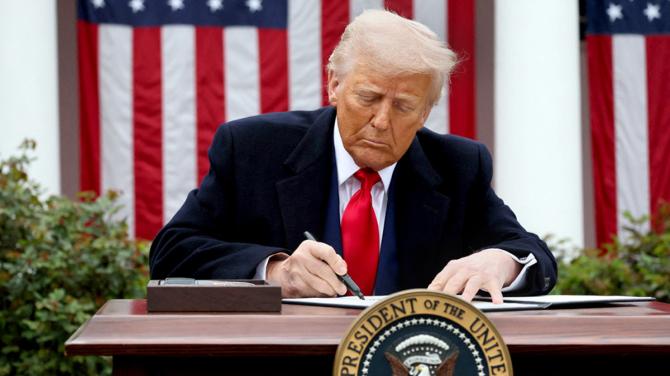
In the face of near-universal warnings from the economic profession, President Donald Trump stuck to the beliefs that he has voiced since the 1980s: That trade deficits are unfair, and that the US needs to impose high tariffs on imports.
No experts, clearly, were involved in the design of these new tariffs, which have been the subject of bemused wonderment across the world in how completely they ignore logic, rationality, fairness, and economic theory.
That they represent a complete departure from how international economics has traditionally been conceptualised is, however, exactly why they are appealing.
Just as Josef Stalin was believed capable of brain surgery by humble Soviet citizens in the 1930s, Mr Trump is considered by his voters to be capable of out-thinking every single economist.
Mr Trump is not the only populist who has taken economic theory head-on.
Turkish President Recep Tayyip Erdogan spent years tilting at windmills of conventional monetary policy.
He has always believed, counter to every economic model and passage of economic history, that high interest rates actually cause inflation -- and has fired a central bank governor who raised rates to deal with galloping prices.
The politics behind such decisions is easy to understand. Populists define themselves against an old, entrenched elite that they say is holding back interests of real citizens.
The squealing of economists that some policy measure is completely deranged can be presented to the populists' followers, then, as the old elite is up to its old tricks again.
That is certainly the case in the US at the moment.
Multiple members of the MAGA (Make America Great Again) movement have asked why we should believe economists on the effects of tariffs when the profession was so wrong about the benefits of globalisation in the first place.
The fact that economists were not in fact wrong about those effects, and that the US today is richer than it ever has been, is irrelevant politically.
The effects of a bold and unconventional decision like the Liberation Day tariffs eventually play themselves out, and are inevitably revealed to be a net negative for everyone's welfare.
But this does not mean that anyone has to change their mind.
The decision was correct; that old entrenched elite prevented regular Americans from benefiting, yet again.
Populist leaders are an unavoidable product of democratic politics.
They pop up every few decades, and if countries are very fortunate, such a leader serves time in office without taking too many decisions of the sort that defy conventional wisdom.
Russia cannot endure too many more invasions; the US will not endure much higher tariffs; and India has thankfully forgotten demonetisation.
Nothing caused me to remember those dark days in 2016 as much as listening to Mr Trump defy logic and economics while announcing his tariffs.
Feature Presentation: Aslam Hunani/Rediff.com








 © 2025