As Sri Lanka [Images] heads for yet another civil war, Tamil refugees have begun fleeing the fighting and taking shelter in Tamil Nadu.
Special Correspondent A Ganesh Nadar traveled to Mandapam to speak to the refugees and find out what is going on in northern Sri Lanka.
The third of a four-part series.
Part I: Lives in exile
The Mandapam relief camp for Sri Lankan refugees is under a special deputy collector for rehabilitation. The man in charge is S Palraj. He has 3,450 people staying here at present, but the number rises daily.
The refugees are registered as they come in. After a meal, they are sent for police interrogation before being allotted quarters. Families are given ration cards. Every month, the government gives Rs 200 to the heads of families, Rs 144 for other adults, Rs 90 for adolescents and Rs 45 for children under 12.
Part II: Mandapam survives on refugees
Rations are given every 15 days. An adult gets 6 kg of rice; a child, 3 kg -- all at 57 paise per kg. Sugar is calculated at 400 grams per person. A family also gets 5 litres of kerosene every fortnight.
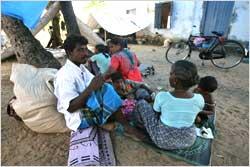 Palraj says the Sri Lankans are allowed to go out and work, provided they return by 7 pm. The camp can accommodate 10,000, but the government will consider shifting them to other camps after the number of inmates crosses 5,000 people.
Given the sudden influx, the priority at present is water and electricity. The government has allotted Rs 4 lakh (Rs 400,000) for improving toilets, Rs 12 lakh (Rs 1.2 million) for roads within the camp and Rs 2 lakh (Rs 200,000) for houses and doors. There are six toilets for every 20 houses.
The deputy collector says all repairs will be done within a month. To assist him are two tahsildars, one deputy tahsildar and seven revenue inspectors. It is like the revenue department of a small town.
There is a government higher secondary school within the camp, where locals from the village also study. Sri Lankan students are admitted without any certificate and allowed to join any class they wish to. A declaration of age is taken from the parents though. At present, the school has 1,200 students and 55 teachers. There is also a 13-bed hospital in the camp, with three doctors, nurses and allied staff. There is a police station manned by both sexes.
The camp has been functioning since 1971. Originally a medical camp for people coming from Sri Lanka, it served as a relief camp for repatriates from Burma for a while but since the disturbances in Sri Lanka in 1983, it has become a landing point for refugees.
The police say there are no law and order problems here. Interrogation of refugees, when they land, is not done by the local cops but by the 'Q' branch of the state police. According to Christopher Nelson, Deputy Inspector General of Police, "The 'Q' branch is well versed with terrorists. If they have any suspicions about a person, he is sent to a separate camp in Chengalpattu. The rest can stay here peacefully."
The special deputy collector stays at the camp, and refugees have to take his permission for overnight stay outside. And outsiders need his permission to go in.
It is a small world all by itself, where inmates sleep without fear of violence.
Photograph: Prakash Singh/AFP/Getty Images
Next: 'We walk without fear here'


 Advertisement


 Email this Article
  Print this Article