Home > Movies > Interviews
'Dum is not about the power of the bicep. It is about soul'
January 23, 2003 13:04 IST
"Please wait for me in my van. I'll be back after this shot," assures a tall guy clad in a black vest and jeans. His arms and forehead are soaked in artificial blood.
When Sukanya Verma met him, Vivek Oberoi was finishing the last schedule of Dum at Kamalistan Studios. It is his Dum costar Diya Mirza's birthday. And Vivek has thrown a surprise party for her. 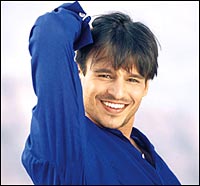
The former Miss India-Asia Pacific is thrilled to find herself in a room decorated with balloons and confetti with a chocolate cake. The unit sings Happy Birthday and Vivek gifts her a lifesized Winnie the Pooh.
That is probably what distinguishes Vivek from his peers. He is spontaneous. He is as affectionate to people as he is passionate about his work.
2002 was his golden year as it realised his childhood dream of becoming an actor. His unconventional debut of an aggressive gangster in Ram Gopal Varma's crime drama Company found favour with critics and masses. Post Company, he featured in the slick thriller Road and the romantic Saathiya.
He has not had a blockbuster yet, but he has the poise and confidence of a superstar. Whether he will achieve the ranks of Shah Rukh Khan, whom he calls God, remains to be seen.
The promos of Dum look sleek. What is it about?
Dum is about an ordinary, simple, middle class guy who lives in a chawl, has good friends, a girlfriend. He sings, dances and has a great family. He stands out because he is staunch in his beliefs. He would pay any price to uphold his principles. He is an incorruptible spirit.
It is very simple to say I have principles. But how far will you go for your principles? Unless your morals are put to the test, they are never really morals. They are just a set of values. It is an interesting philosophy until it is put through fire. 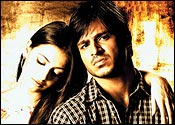
Dum is not about the bicep. It is about soul.
You are known to be quite the prankster. Were you always this mischievous?
I spent my higher secondary education at Mayo School, Ajmer, where I had a blast. I had lots of friends and I did a lot of masti. I was a very good student as well as a good sportsperson. Somewhere, I had a little bit too much extra energy, which I still do.
I was always playing pranks. I was always up to mischief. Woh aadat abhi tak gayi nahin (That habit still persists).
Recently, we did a four day-four night schedule in Mahabaleshwar [a hill station in Maharashtra] for Dum. The atmosphere was relatively relaxed and we had an off next day. I decided kal chutti hai (tomorrow is a holiday), so tonight we have to have a wild time.
I took a watchman's torchlight and covered my head with a shawl. I went from room to room making ghostly sounds. Then I caught hold of the watchman, and asked, "Did you guys hear something?"
I spread some rumours: "Fifteen years ago, someone died here. His spirit is still here."
The whole unit was awake all night. And they all had stories to tell. Once I triggered their imagination, they were all like, 'Haan maine bhi dekha (I saw it too)'. All the guys in the unit started talking.
We were shooting a song sequence once. It was a rain sequence. Diya and I were dancing and were soaked through and through. My director E Niwas, a unit member Vaibhavi, her assistant, cameraman Suri, executive producer Komesh, were all standing in one group and discussing the shot.
I was waiting. Then I took hold of the hosepipe and fired the sprinkler right at them. And then I was like, "Now you all know, how it feels." It is fun. I have always been like that.
Like nobody could believe it was Diya's birthday today. Because in Mahabaleshwar, I fired the whole unit one day, saying, "Have you any shame? It is Diya's birthday and you guys haven't wished her."
When Diya came to the sets, everyone started wishing her. Diya kept saying it wasn't her birthday. I told everyone she was saying that because she was upset everyone had forgotten it was her birthday, and asked them to sing to her.
The whole unit went sang to her. She got tired explaining it wasn't her birthday. That's why I decided to throw her a surprise birthday party today. In fact, everyone was so wary, they asked me, "Are you serious or are you joking?"
Do people behave differently now that you are successful? Do they get intimidated by your star status?
I don't think anyone is intimidated by me. I don't get intimidated by people. I don't intimidate them either. I have never thought of myself as a star. I don't believe in stardom -- it's an absolute myth. It's a fallacy. As an actor, I would rate myself somewhere between 1 and 2 on 10. 
I have a long, long way to go. I am glad my profession not only pays the bills but also gives me a creative outlet and satisfaction.
What kind of fan mail do you get?
I get very sweet fan mail. I get a lot of fan mail from all age groups -- men, women, girls, boys, little children.
I hop into McDonald's at times, pick up something and walk out, say hello to everybody. People ask me for autographs so I give it. When it gets messy, I excuse myself. I tell them, "I have to go, sorry guys," and leave.
Who was the first person to know about your aspiration to act?
I think I was about seven when I enrolled at the Trinity College, London, for a correspondence course in speech and drama. By the time I was 10, I told my dad very seriously about acting. He said, "It is good to desire but never desire without deserving."
I asked him how to go about it. He told me exactly what to do. I followed it. I completed my graduation. At 20, I left to do a course in film studies at the New York University. I did a campaign for Chanel and Boucheron -- they were paying me enough money to start my education.
My uncle Mahesh Oberoi (Suresh Oberoi's younger brother) who lives in Princeton, New Jersey, supported me through the rest of it. He and his wife Madhu are like my second parents. They are always there for me. A part of me is still attached to the United States with my Chacha-Chachi.
You never faced any disapproval from your parents about your decision to pursue acting.
My parents have pursued my dreams more enthusiastically than me.
What is your relationship with your siblings like?
Fantastic. When I have to be an elder brother to my sister, I am. When I have to be her friend, I am. When I have to be a sister to her, I am. There are times you may have to change your perception, your approach of talking to someone. That's why we get along very well because she is all those things to me. 
My relationship with my brother is great, too. We grew up like friends and get along famously. We share the same passion for cinema. My brother is now studying at the Tisch School of Arts at New York University.
You had long hair earlier. Why did you chop it off?
I had long hair when I was 20, when I was modeling in the States. I cut it because I get tired of things very fast. I get bored fast. That's why I enjoy being an actor; I can be different people every day.
I want to be someone else all the time. It could by Uday Shinde (Dum), it could be Chandrakant Nagre (Company), it could be Aditya Sehgal (Saathiya). Jab hum kissi kirdar ko nibhate hain, toh hamara koi ansh usmein sama jaata hai (When we play a character, a part of us gets immersed in the character). Us kirdar ki koi chhap humari aatma mein lag jaati hai (And that character leaves a mark on our soul).
You seem to always do your own thing. Are you the fiercely independent kind?
It is an interesting contradiction. I was four when I flew my own. Yet I cannot live without my family. One of the reasons why I didn't want to live in New York in spite of all the openings and work possibilities to be explored was because I loved India. I want to be here. Mumbai is where my heart is. This is home.
You sound very self-assured and confident.
I like to take certain things for granted. This is something I have set myself to do and I will do it. But there are different ways in which we chart our goals. I have chosen to take each day at a time.
If I said I was supposed to make Rs 10 crore this year, and I made only 9, I would start talking about the 10th one that didn't come in. That's where we go wrong. We just count the zeroes. We stop to enjoy the power of a two-rupee vada pav. We want more. 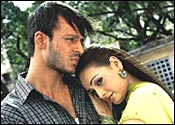
We get fixated with the end all the time and not the means. Sometimes the means can be more pleasurable.
Is there any particular philosophy that you adhere to?
I am a simple person, I come from a very simple home. We believe in enjoying life and what we have. I am very privileged to have the parents and family that I do. Aakhir sanskar-sanskriti humein ghar se hi milti hai (One imbibes values and morals from one's family).
You write poetry, you dabble with film scripts, have you ever thought of writing a full fledged script for yourself?
That's the idea. I wrote a script for Vidhu Vinod Chopra. I am writing another for Ram Gopal Varma. I don't know about direction. There is too much people management involved.