
'Legally clean farmland is difficult to find. It requires time, money, and legal effort to verify the title.'
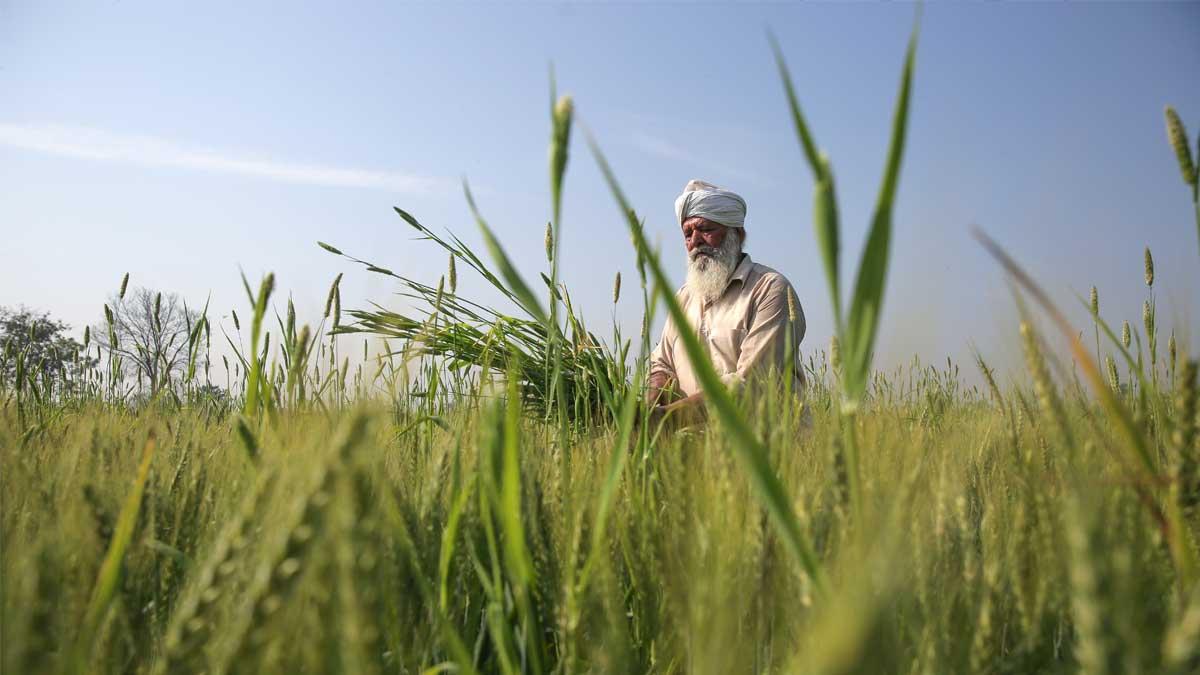
IMAGE: A farmer cuts away weeds from his unripe wheat crop on his farm. Photograph: ANI Photo
A leading actor's daughter is facing legal trouble over her purchase of agricultural land outside Mumbai, according to media reports.
The plot was originally earmarked for agricultural use and could not be transferred without obtaining the necessary permissions and completing the required paperwork, which was not done.
Investors planning to invest in agricultural land outside a major city to benefit from its expansion need to exercise caution.
City's growth drives prices up
Buying land on the city outskirts with a long horizon can be rewarding.
"Urbanisation creates demand and leads to appreciation in the value of such land," says S G Raja Sekharan, wealth management expert and author of the book, How To Get Rich And Retire Early, which deals with investing in agricultural land.
Investing in agricultural land also diversifies an investor's portfolio.
"Investors can enjoy the benefits of various incentives and subsidies offered by the government. They can also enjoy tax savings under the rules applicable to agricultural income," says Santhosh Kumar, vice chairman, Anarock Group.
Illiquid asset
Investing in agricultural land comes with its share of risks.
"There are strict limitations on how agricultural land can be used," says Kumar.
It is also among the most illiquid asset classes.
"Selling and exiting quickly may prove difficult," he says.
Zoning law changes can impact value. If conversion to non-agricultural use is restricted, the prospects for appreciation decline. Encroachment is another concern.
Compensation in the event of government acquisition may be lower for such land. Cash dealings are common.
"Finding buyers or sellers willing to transact entirely in white money is difficult," says Raja Sekharan.
Title disputes and other risks
Title disputes are common, with extended family members often raising ownership claims. Poor documentation is widespread.
"Legally clean farmland is difficult to find. It requires time, money, and legal effort to verify the title," says Raja Sekharan.
"The absence of mutation records increases risk. Pending litigation may cloud ownership rights," says Asha Kiran Sharma, partner, King Stubb & Kasiva, Advocates and Attorneys.
She adds that encumbrances such as mortgages, court attachments, or acquisition notices may also affect ownership.
The Foreign Exchange Management Act (FEMA) rules impose further restrictions.
Non-resident Indians and foreigners cannot buy agricultural land unless they inherit it or obtain special authorisation.
Sellers may also at times make false promises of regularisation or conversion.
Abide by state laws
State laws can pose further hurdles.
"Restrictions under state laws may block ownership," says Shweta Tiwari, associate partner, IndiaLaw.
Rules vary across states.
"Many states do not let people who are not farmers or do not have a farming history acquire farmland, unless they can show proof of eligibility or get special permission," says Kumar.
"In Maharashtra and Gujarat, only agriculturists can buy, while non-agriculturists need prior approval from the Collector.
"In West Bengal, there are no restrictions on the purchase of agricultural land, subject to compliance with ceiling limits and land use conditions.
"In Himachal Pradesh, outsiders cannot buy farmland without state sanction.
"In Nagaland, customary laws restrict ownership to Naga tribes.
"Karnataka recently liberalised its laws, allowing non-agriculturists to buy farmland, subject to income and ceiling conditions," says Anuja N Mukerji, partner, Aquilaw.
If non-agriculturists are not permitted to buy agricultural land, they should obtain permission from the authorities.
"Transactions without the collector's approval can impair the validity of the purchase," adds Mukerji.
Pay the right price
Buyers must check recent transactions to ensure they are paying the right price.
"The price you pay should be in line with market trends. Negotiate to ensure you get a good price," says Sekharan.
Location is critical. "Make sure the land parcel is likely to be included in future development plans of the city," adds Sekharan.
Land within 10 kilometres of a metro's boundary is more likely to gain value as the city expands.
Sekharan adds that land must be held for at least 10 years to generate meaningful returns.
Thorough title check is a must
Investors must confirm they are eligible to purchase the land and ensure a clear title.
"Land records, encumbrance certificates, and conversion permissions should be checked carefully," says Sharma.
A 7/12 extract, issued in states such as Maharashtra and Gujarat, provides key details about agricultural land.
"The 'other rights' column in the 7/12 extract may reveal tenancy or statutory restrictions," says Mukerji.
Tiwari suggests conducting a physical survey of the land before purchase.
Know the tax rules
Rural agricultural land is not treated as a capital asset, so gains are not taxable.
Urban agricultural land attracts capital gains tax.
A holding period of more than 24 months leads to long-term capital gain (LTCG), while a period of 24 months or less results in short-term capital gain (STCG).
"STCG is taxed at the individual's slab rate.
"LTCG is taxed at 12.5 per cent without indexation for transfers on or after July 23, 2024, or 20 per cent with indexation for transfers made before this date.
"Surcharge and cess also have to be paid," says Suresh Surana, a Mumbai-based chartered accountant.
Surana adds that if rural land comes within municipal limits or distance thresholds at the time of transfer, it becomes taxable.
Red flags to watch out for
- Missing or incomplete mutation records
- Unclear or disputed titles
- Pending litigation
- Restrictions under tenancy, ceiling, or state laws
- Encumbrances like mortgages, attachments, acquisition notices
- False promises of regularisation or conversion
- Transactions without mandatory approvals
Disclaimer: This article is meant for information purposes only. This article and information do not constitute a distribution, an endorsement, an investment advice, an offer to buy or sell or the solicitation of an offer to buy or sell any securities/schemes or any other financial products/investment products mentioned in this article to influence the opinion or behaviour of the investors/recipients.
Any use of the information/any investment and investment related decisions of the investors/recipients are at their sole discretion and risk. Any advice herein is made on a general basis and does not take into account the specific investment objectives of the specific person or group of persons. Opinions expressed herein are subject to change without notice.
Feature Presentation: Ashish Narsale/Rediff












 © 2025