

Photographs: Catherine Benson/Reuters
Get ready for the next-generation computers and smartphones that are up to 1,000 times faster than the systems you use today.
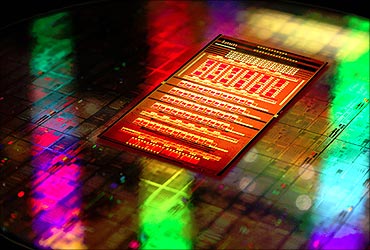
Computer maker IBM is developing 'skyscraper' computers using huge sandwiches of silicon chips by sticking layer after layer of chips covered with tiny components together.
The process, for which IBM has roped in glue maker 3M, will make PCs and smartphones up to 1,000 times faster than the existing ones and are expected to be available in market as early as 2013.
. . .
By 2013, computers will be 1000 times faster

Photographs: Stephen Hird/Reuters
The attempts at piling chips vertically -- known as 3D packaging -- has so far been suffering from overheating.
But, the new glues could potentially conduct heat through a stack of densely-packed chips and away from logic circuits that could be burnt out by the heat.
. . .
By 2013, computers will be 1000 times faster
Photographs: Rhee Dong-Min/Reuters
Mike Bowman, marketing manager for 3M, said: "This material fits underneath computer chips when they're attached to printed circuit boards -- the unique part of what we're doing is that our glue conducts heat out to the edge of the sandwich.
"Our glue will spread heat more evenly through the chip. With conventional chips, with just one or two layers, but once you're stacking chips, the problem can become very severe."
. . .
By 2013, computers will be 1000 times faster
According to the researchers, a ball of advanced adhesive is placed between layers of chips, allowing up to 100 chips to be stacked without overheating.
"Today's chips including those containing 3D transistors are in fact 2D chips that are still very flat structures," Bernie Meyerson, a vice president of IBM Research, said in a statement.
So far, most increases in computing power have been driven by scientific breakthroughs that allow chip makers to etch ever-smaller circuits onto ever-smaller chip wafers. The new '3D' approach could accelerate gadgets such as tablet computers to unheard-of new speeds.
. . .
By 2013, computers will be 1000 times faster

"We believe we can advance this, and create a new class of semiconductors -- faster, with lower power usage, ideal for tablets and smartphones."
. . .
By 2013, computers will be 1000 times faster
Other 3M glues are used in hi-tech industries such as solar power, as well as in markedly lower-tech environments such as carpentry.
Both companies did not speculate on a release date for the new technology, but insiders said such versions could be on the market as early as 2013.
article