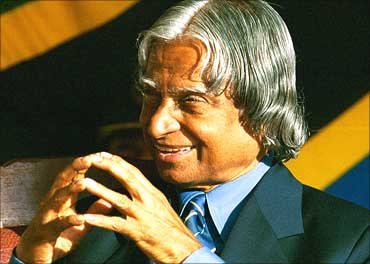
The 'hub' of India's second Green Revolution would be at Paliganj in Bihar with farmers in Paliganj 'immensely contributing' towards optimising foodgrain productivity, former President A P J Abdul Kalam said on Tuesday.
"You all started with 2.4 hectare of land in 1999 and extended it to 2000 hectare by 2004 and during this period, using sound agricultural policies, quality seeds and input material, you have been able to demonstrate that the productivity of rice and wheat can be more than doubled in the five years time," Kalam said, addressing farmers at Paliganj, about 55 km from Paliganj.
. . .
He said the Paliganj farmers should also work in enhancing the productivity during 2016-2020 as this effort would make Paliganj 'the hub' of propagating the second Green Revolution.
He said the trend undertaken by Paliganj farmers should continue and there was a need for making Bihar the 'granary of India.'
Referring to Bihar, Kalam said the net area under cultivation of grains was around 56 lakh hectare and the average yields of rice and wheat in this area was 1.45 and 2.19 tonne per hectare respectively.
. . .
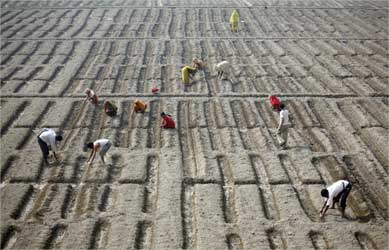
"The Paliganj farmers have proved beyond doubt that they can produce at least four tonnes per hectare of paddy and six tonnes per hectare of wheat.
"It it time that the agriculture universities like Rajendra Agriculture University and other universities in the state work in partnership with farmers of Paliganj and the district development officers of all the 38 districts, so that we can achieve the goal of doubling the productivity of wheat and paddy within the next five years," he said.
. . .
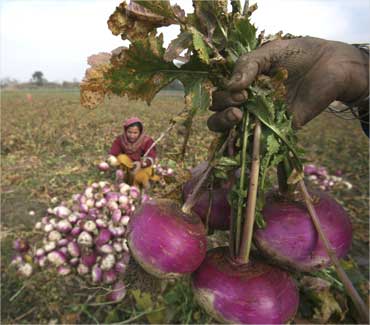
The former President said India has to now embark upon the second Green Revolution which would enable it to increase the foodgrain production from the existing 230 million tonnes per year to at least 340 million tonnes per year by 2020.
Kalam said the increase in production would have to overcome many impeding factors and the requirement of land for the increasing population as well as for greater afforestation and environmental preservation activities would force a situation whereby the preset 170 million hectare of arable land would not be fully available.
. . .
The second Green Revolution would be a knowledge graduation from characterisation of soil to the matching of the seed with the composition of the fertiliser, water management and evolving pre-harvesting techniques for such conditions, Kalam said.
The domain of a farmer's work would enlarge from grain production to food processing and marketing and while doing so, utmost care would have to be taken for various environmental and people-related aspects leading to sustainable development, he said.
Kalam said over the years, arable land would shrink in size and in addition, there would be shortage of water.
"Our farmers have to work in partnership with agricultural scientists and technologists for doubling the productivity of foodgrain, the type of technologies suitable to the area and development of seeds that would ensure good yield," he said.
 © 2025 Rediff.com - Investor Information - Advertise with us - Disclaimer - Privacy Policy - Feedback - About us - Terms of use - Grievances